Rolling stock
The trains Gare names, and how they came to be.
Giruno
Giruno (Stadler SMILE)
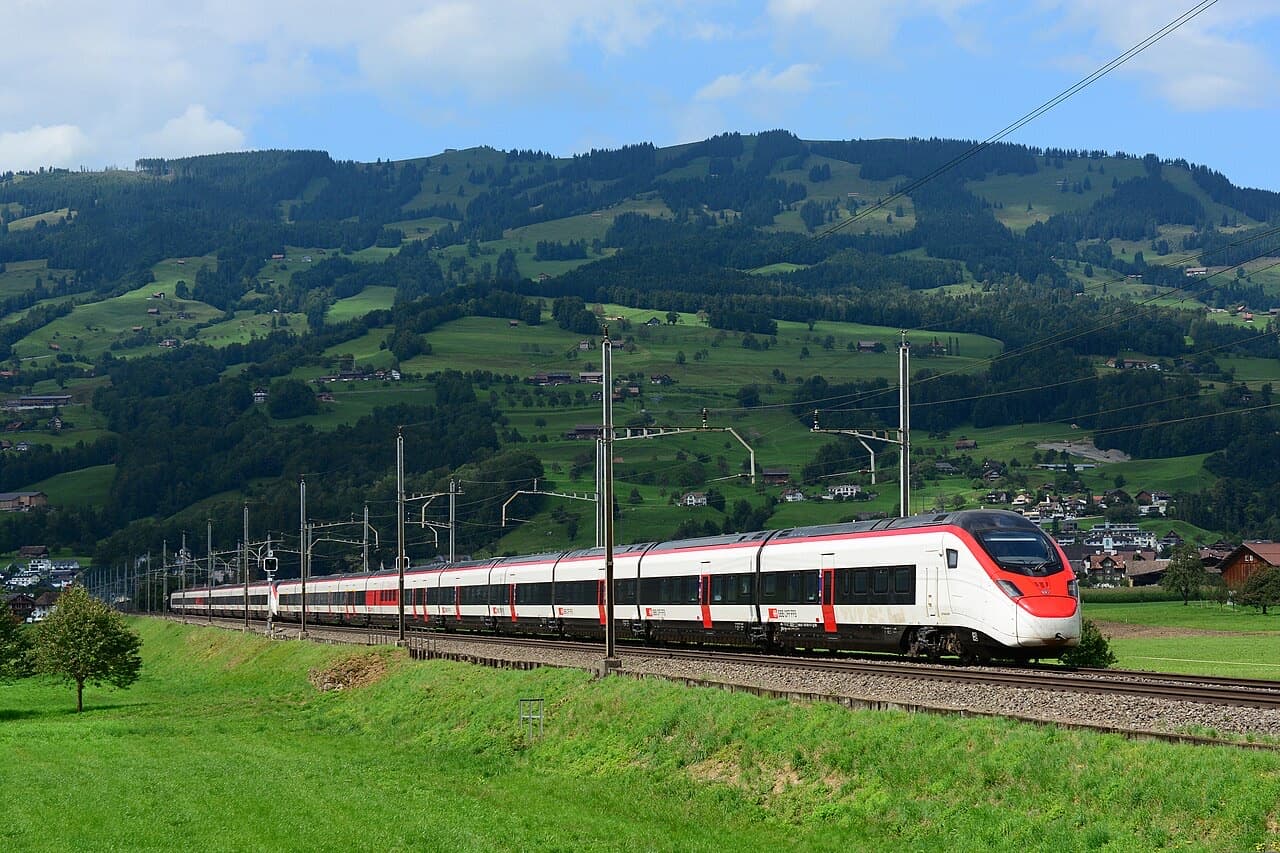
A long single-deck train in white with a red nose, the nose drawn out to a sharp point. Its entrances are level with the platform: doors and floor sit low, without steps. The Astoro, the other white-and-red pointed train on the Gotthard, rides higher, with steps at the doors and a separate bogie under each car; on the Giruno most car joints share one bogie, so the gaps sit right above the wheels.
The Giruno is SBB's high-speed train for traffic through the Gotthard Base Tunnel. SBB has ordered 41 units: the original 29 plus 7 more in 2022 and 5 in 2024, the later batches for growing services to Italy and Germany. They run the Basel/Zürich–Lugano–Chiasso Intercitys and EuroCitys to Milan and beyond, and since 2024 also cross into Germany on the Zürich–Frankfurt route. In December 2025 two daily pairs began running between Basel and Hamburg in double sets; frost-related pantograph monitoring faults briefly put German ICEs in their place over the turn of the year until a software fix. The Austrian private operator WESTbahn also leases three units of the same design.
In 2012 SBB tendered 29 single-deck trains for 250 km/h to serve the new Gotthard Base Tunnel and cross-border routes. Stadler, Siemens, Alstom and Talgo bid; after a second round, SBB chose Stadler in May 2014 for just under CHF 1 billion. Talgo appealed, arguing SBB had favoured the domestic maker, but the Federal Administrative Court dismissed the complaint and the contract was signed in October 2014. Stadler showed a shortened prototype at InnoTrans 2016 and rolled out the first full train in Bussnang in 2017. Approval took longer than planned: passenger service began on 8 May 2019 between Zürich and Erstfeld, regular Gotthard runs followed that December and Milan in August 2020.
An eleven-car Giruno is about 202 m long and seats roughly 400 passengers, 117 of them in first class, plus a restaurant. Two units can couple for a 400 m train. Top speed is 250 km/h abroad and 200 km/h in Switzerland; the train is approved in Switzerland, Germany, Italy and Austria and handles all three of their power systems. Its main selling point at home is step-free boarding: floors at the doors match platforms from 55 to 76 cm, so wheelchair users can roll in without lifts. Criticism after introduction focused on reliability in the first years, noise insulation, narrow aisles and a cramped first-class layout. It is seen mainly on the Gotthard axis from Basel and Zürich to Ticino and Milan, and on routes into Germany.
RABe 501
Swiss multiple units are named by what the whole train contains. R marks a vehicle faster than 110 km/h, A and B first and second class, e electric traction; together "RABe" means a fast electric train with both classes on board. The 5xx series covers standard-gauge multiple units, and 501 follows the ICN (500). The train is articulated: apart from the outer ends, neighbouring cars share a single Jacobs bogie instead of each resting on two of their own, which saves weight and keeps the cars from swaying apart. Stadler sells the design as SMILE, short for "Schneller Mehrsystemfähiger Innovativer Leichter Expresszug"; "Giruno" is Romansh for buzzard.
FV-Dosto
FV-Dosto (Bombardier Twindexx Swiss Express)
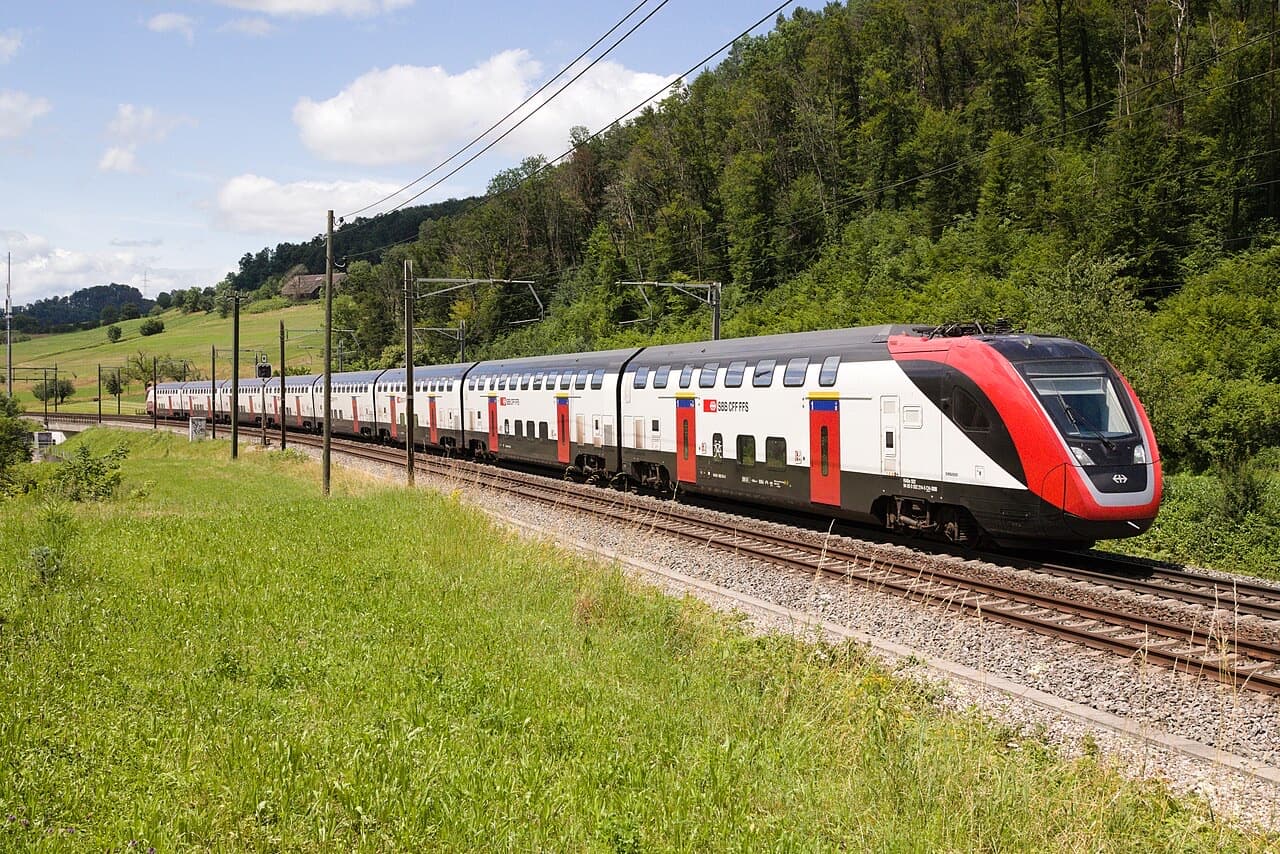
Double-deck throughout, with a sharply angled red nose and a black window band at both ends, and no separate locomotive; the pantographs sit on the train's own cars. The IC2000, the other SBB double-decker, has a locomotive at one end and a blunt control car at the other.
SBB runs 62 FV-Dosto: 23 IC 200, 30 IR 200 and 9 IR 100. Ride comfort has been their weak point. The trains were built with "Wankkompensation" (WAKO), an active system meant to lean the body against curves so they could take them faster; in practice it was failure-prone, and passengers nicknamed the train "Schüttelzug" for its shaking. SBB stopped using WAKO in 2022 and in December 2025 decided to remove it from the whole fleet, fitting simpler suspension at a cost of about CHF 90 million that lower maintenance should recover. The first rebuilt train entered service on 30 September 2026; the rest follow during regular overhauls into the early 2030s.
SBB tendered new double-deck trains in 2009 to expand capacity under its long-distance plans. Bombardier beat Siemens and Stadler and won the contract in May 2010: 59 trains for about CHF 1.9 billion, the largest order in SBB history. Service was due in December 2013. Development of the tilt-compensation system, software problems and the approval process pushed this back by more than four years; provisional approval came in late 2017 and the first trains carried passengers in early 2018. Disability organisations challenged the steep ramps inside the doors up to the Federal Supreme Court, which in 2021 required every entrance ramp to stay within 15 % gradient. Bombardier added three trains as compensation for the delays, and the last of the 62 was delivered in 2022.
The eight-car versions are about 200 m long and seat around 600 (IC 200, which includes a restaurant) to 680 passengers (IR 200); the four-car IR 100 seats about 330. Top speed is 200 km/h. Unlike the IC2000, the doors sit at platform height and lead via short ramps onto the lower deck, so wheelchair users can board without a lift, though the ramps remain a point of contention. Passengers have criticised the jerky ride, especially upstairs and through station points, and early reliability problems. The trains run on main Intercity and InterRegio routes, including the Geneva–Bern–Zürich–St. Gallen IC1 axis, Basel–Zürich–Chur and InterRegio services out of Zürich.
RABDe 502 (IC 200), RABe 502 (IR 200, IR 100)
R marks a vehicle faster than 110 km/h, A and B first and second class, e electric traction. The IC variant adds a D for its luggage compartment, hence "RABDe"; the InterRegio variants lack it and are plain "RABe". The 5xx series covers standard-gauge multiple units, and 502 follows the ICN (500) and Giruno (501). "FV-Dosto" is SBB shorthand for Fernverkehrs-Doppelstocktriebzug, long-distance double-deck multiple unit. The suffixes describe the versions: IC 200 and IR 200 are eight-car trains of about 200 m, IR 100 a four-car train of about 100 m. Bombardier called the design Twindexx Swiss Express; the maker has since been absorbed by Alstom.
Astoro
Astoro (Alstom ETR 610, New Pendolino)
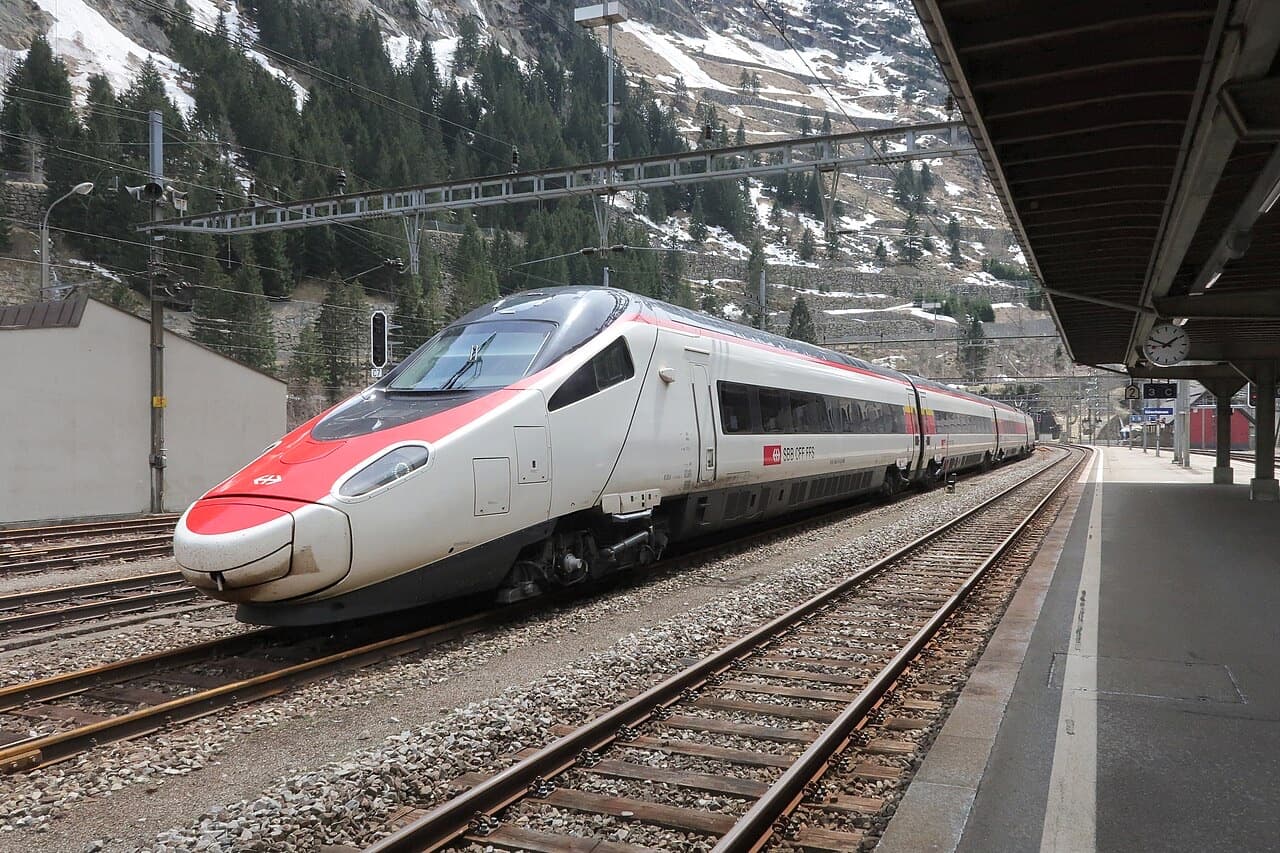
A white single-deck train with a long, rounded nose capped in red, its headlights low on either side and the windscreen set high and far back. Doors have steps, and each car rides on its own pair of bogies. The Giruno, its look-alike on the Gotthard, has a sharper nose, level boarding and shared bogies at most car joints.
SBB owns 19 Astoro; Trenitalia runs the other seven of the 26 built as Frecciargento and EuroCity trains. Since the Giruno took over most Gotthard services, SBB's Astoro mainly cover the Simplon routes from Geneva and Basel (via the Lötschberg) to Milan, and since December 2020 the EuroCity-Express between Zürich and Munich via Lindau, where tilting shortens journeys on the curvy line through the Allgäu. After a costly start, SBB put the trains through a maintenance programme from 2016 to address problems with the tilting system and drivetrain.
The Astoro began as a replacement for the Cisalpino ETR 470, an earlier Pendolino whose unreliability had damaged the reputation of Swiss–Italian trains. In 2004 Cisalpino, the joint SBB–Trenitalia company, ordered 14 ETR 610 from Alstom, which had taken over Fiat Ferroviaria and its Pendolino tilting technology; Giorgio Giugiaro styled the exterior. Delivery was late and the first trains entered service between Geneva and Milan in July 2009. Cisalpino was dissolved at the end of that year and its fleet split equally, seven units each. Needing more trains for traffic to Italy, SBB ordered eight more in 2012, delivered 2014–2015, and four in 2015, delivered 2016–2017. They joined Gotthard services in December 2015.
A seven-car unit is about 187 m long and seats about 420–430 passengers, around 108 in first class, plus an 18-seat restaurant. Top speed is 250 km/h, reached on Italian high-speed lines; tilting lets it take curves faster on conventional track. The train handles three power systems: 15 kV 16.7 Hz in Switzerland and Germany, 25 kV 50 Hz on Italian high-speed lines, and 3 kV DC on the rest of the Italian network. Boarding is by steps, so wheelchair users need a lift. The early years were marked by breakdowns and delays that hurt the train's reputation. In Switzerland it is seen mainly on the Geneva–Lausanne–Valais–Simplon line, Basel–Bern–Lötschberg–Brig and between Zürich, St. Gallen and Munich.
RABe 503 (SBB); ETR 610 (Trenitalia)
In Italy the train is an ETR 610: ETR stands for ElettroTreno Rapido, the Italian class for high-speed electric multiple units, and 610 is its series in the Pendolino family. SBB registered its later units under the Swiss scheme: R for faster than 110 km/h, A and B for first and second class, e for electric traction, and 503 in the long-distance multiple-unit series after the ICN (500), Giruno (501) and FV-Dosto (502). The ex-Cisalpino units first kept their Italian 610 numbers. Each of the seven cars rests on two conventional bogies, and the bodies tilt actively by up to 8°. "Astoro" is the name SBB has used for its fleet since 2018.
ICN
ICN (InterCity-Neigezug)
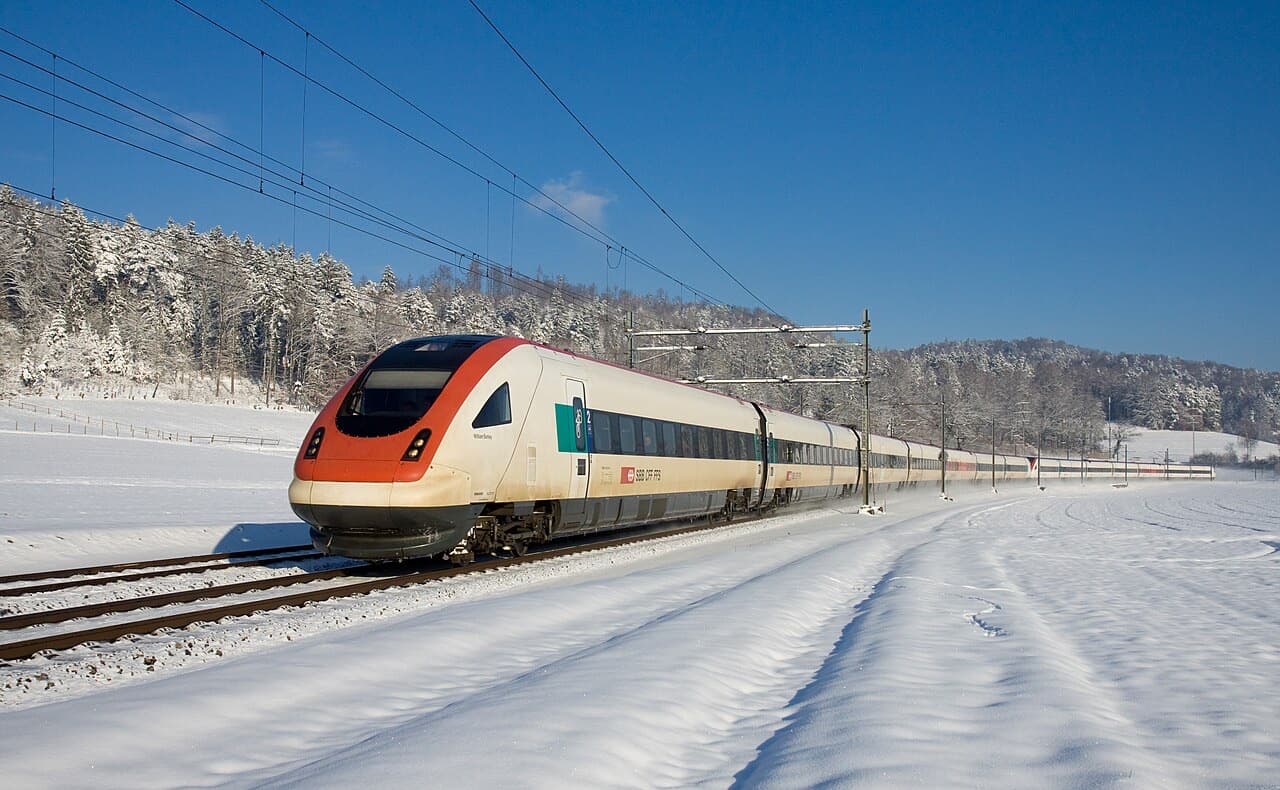
A single-deck train with a short, rounded red-orange nose and a large sloping windscreen. The car sides lean inward towards the roof, to leave room for tilting in curves. No locomotive: both ends have a driving cab.
All 44 ICN are still in service and are being modernised for a further 20 years. After about eight million kilometres each, the trains reached mid-life; since 2021 SBB has been overhauling them at its Yverdon-les-Bains works for more than CHF 500 million. The first fully renewed train was presented in October 2024, and seven to eight per year follow until about 2031. The overhaul brings re-upholstered seats, new carpets, tables with sockets, larger passenger-information screens, better mobile reception, new lighting, renovated toilets and a refreshed restaurant, plus new wheelsets, motors and paint. The ICN remains the standard train on the Jura foot line between Geneva or Lausanne, Biel and Zürich.
The ICN was ordered for Bahn 2000, which needed shorter journey times on the winding Jura foot line between Lausanne, Neuchâtel, Biel and Olten to make its connections work. Building new track there was too expensive, so SBB chose tilting trains. In 1996 it ordered 24 units from a consortium led by Adtranz with Schindler Waggon and Fiat-SIG, which supplied the tilting bogies; Pininfarina shaped the exterior. Passenger service began with the May 2000 timetable between St. Gallen, Zürich and Lausanne. SBB added 20 more units in 2001, and deliveries ended in 2005, by which time Adtranz had become part of Bombardier. For years ICNs also ran over the Gotthard to Lugano until the Giruno replaced them.
A seven-car ICN is about 189 m long and seats roughly 450 passengers plus about 20 in the restaurant; two units often run coupled. Top speed is 200 km/h. Sensors in the leading bogie and an electric drive tilt the bodies by up to 8° in curves, which makes the trains about 10–20 % faster than conventional stock on winding lines. The price is a narrower body cross-section, tighter seating than the IC2000 and a swaying ride that leaves some passengers queasy. The floor is high, so wheelchair users board by lift. ICNs mainly run the IC5 from Geneva or Lausanne via Neuchâtel and Biel to Zürich and St. Gallen, the IC51 Basel–Biel and InterRegio services in western Switzerland, with occasional appearances elsewhere.
RABDe 500
R marks a vehicle faster than 110 km/h, A and B first and second class, D a luggage compartment, e electric traction; so "RABDe" is a fast electric train with both classes and luggage space. Swiss standard-gauge multiple units are numbered in the 5xx series, and the ICN, as the first, is 500. "ICN" stands for InterCity-Neigezug, InterCity tilting train. The seven cars ride on conventional bogies: the four outer cars are powered on one axle per bogie, written 1A'A1', while the three middle cars run on unpowered 2'2' bogies, giving the formation 1A'A1'+1A'A1'+2'2'+2'2'+2'2'+1A'A1'+1A'A1'. Each unit carries the name of a Swiss personality, from Le Corbusier to Robert Walser.
IC2000
IC 2000 (Doppelstock-Intercity, DOSTO)
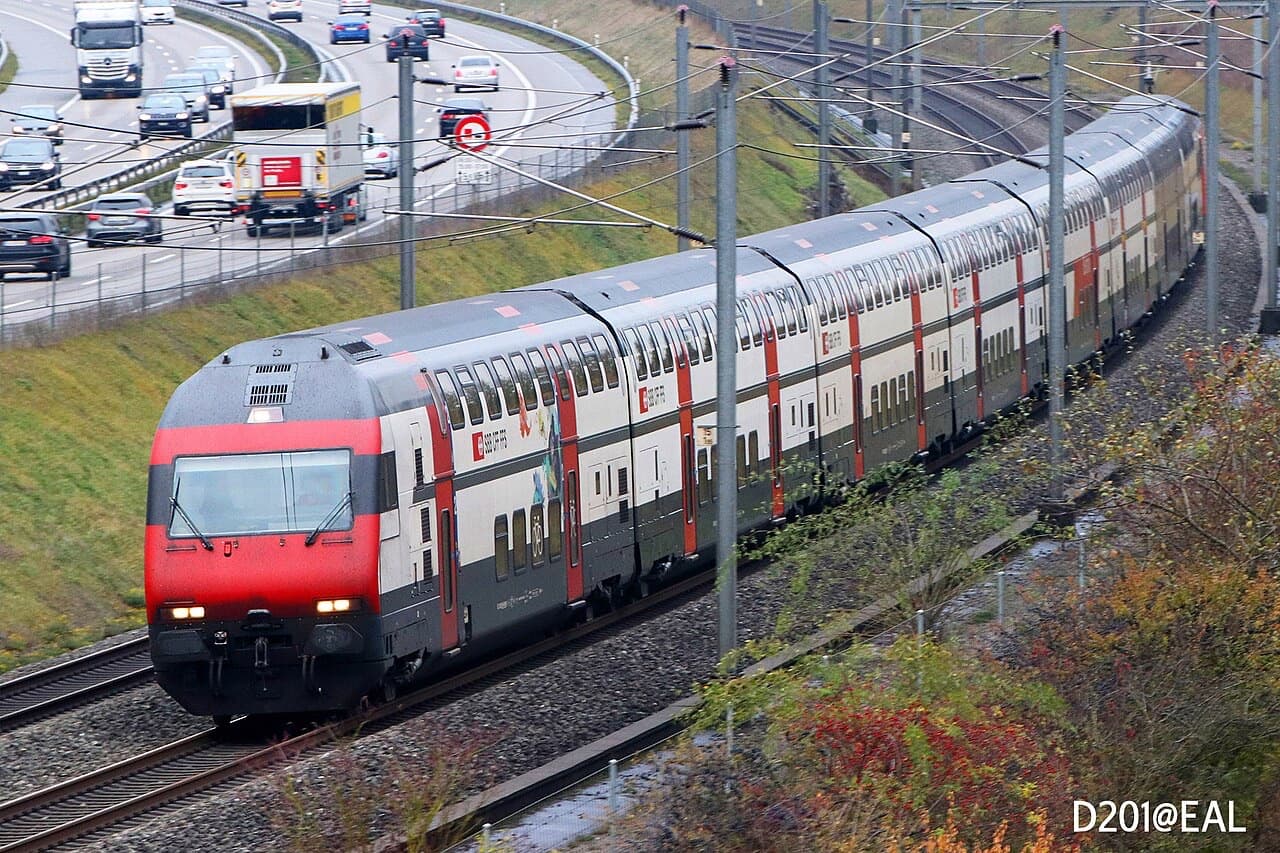
Double-deck coaches with a separate locomotive at one end — usually a red Re 460 with a rounded nose — and a control car at the other. The control car has a blunt, near-upright red front with the windscreen at mid height, between the two decks. Red doors sit at both ends of each coach. The FV-Dosto, the other SBB double-decker, looks similar from the side but has a pointed nose at both ends, pantographs on its own cars, and no locomotive.
The IC2000 is the backbone of SBB's long-distance fleet: up to ten double-deck coaches with an Re 460 at one end and a control car at the other, carrying close to a thousand seated passengers. Between 2019 and 2024 all 341 coaches were refurbished in the "IC 2020" programme, which brought new seats, carpets, sockets at every seat, and signal-permeable windows for mobile reception. The refreshed fleet is planned to run until about 2036–2043.
The IC2000 grew out of Bahn 2000, the 1987 plan to run hourly or better connections between every major Swiss node. More trains alone would not fit on the busy east–west axis, so SBB ordered bigger ones: in the early 1990s it chose double-deck coaches, a first for nationwide long-distance service. A consortium led by Schindler Waggon (final assembly, later Bombardier), with Flug- und Fahrzeugwerke Altenrhein building the aluminium bodies and FIAT-SIG the bogies, delivered 341 coaches between 1997 and 2004. They entered service on the Geneva–Zürich–St. Gallen axis and soon became the face of the Swiss Intercity.
Each coach is about 26.8 m long and a full ten-coach set with locomotive runs to roughly 280 m. Top speed is 200 km/h, though most lines limit them to 160 km/h; the bodies are pressure-sealed for tunnels. The upper deck offers the view, the lower deck — a third of the train is low-floor — level boarding at 55 cm platforms. Because the coaches exceed the standard loading gauge, they only run on lines cleared for them: the Geneva–Lausanne–Bern–Zürich–St. Gallen IC1 corridor, Brig–Bern–Zürich–Romanshorn (IC8), Basel–Bern (IC6/IC61), and IR services towards Lucerne and Konstanz. Passengers rate the ride as smooth and the upper deck as pleasant; criticism centres on narrow stairs, crowded vestibules at peak hours and luggage space that falls short for airport and holiday traffic.
AD, A, AS, B, WRB, Bt — type "2E", hauled by an Re 460
Swiss coach codes start with the class: A is 1st, B is 2nd, AB both. Extra letters add a function — D a luggage area, R a restaurant (WR a full dining car, WRB a bistro with 2nd-class seats), S an accessible section, t a driving cab ("Bt" is the control car at the far end). The bracketed "(2E)" is the type tag SBB's formation data uses to set the IC2000 family apart from other coaches with the same class letters. The coaches have no motors: an Re 460 pushes or pulls them — R for a locomotive faster than 110 km/h, e for electric, 460 its series — so a full train reads "Re 460 + AD + A + … + Bt".
EW IV
Einheitswagen IV (EW IV, standard coach IV)
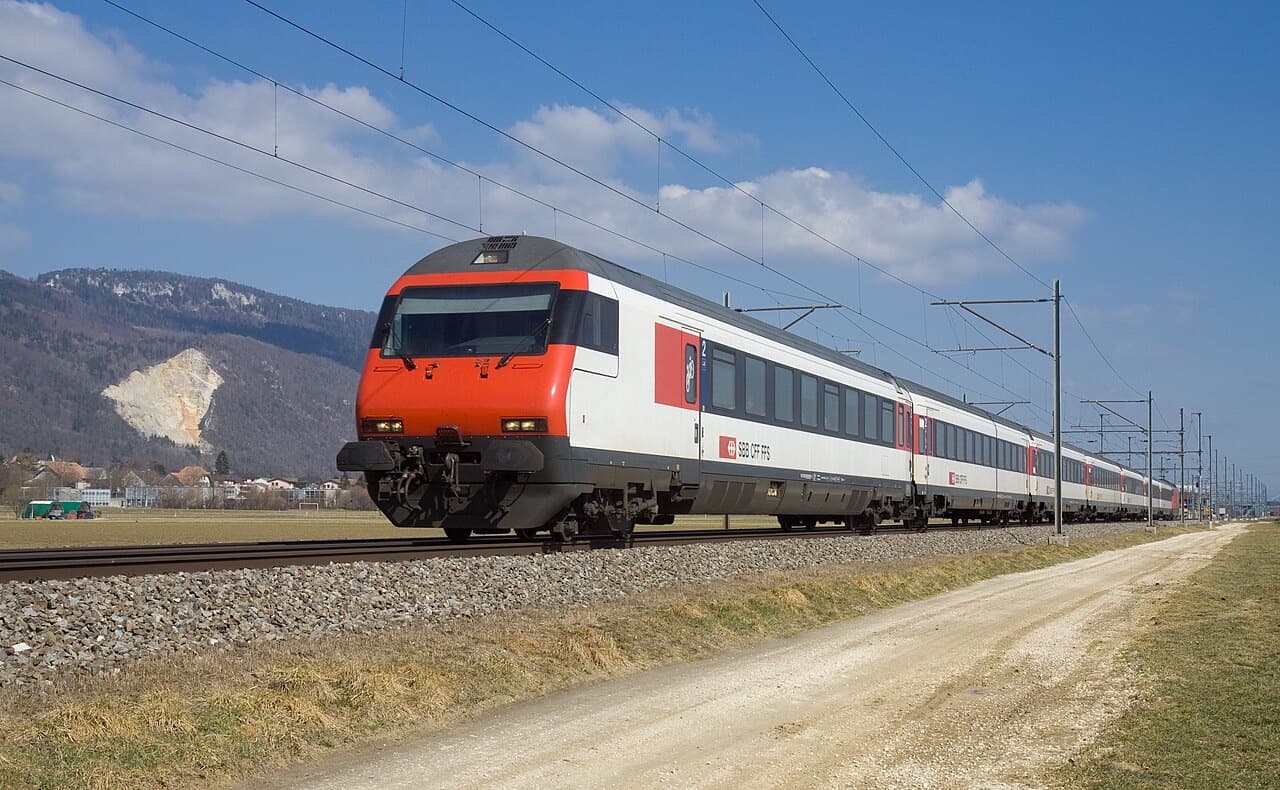
Single-deck coaches in white with a dark window band, pulled or pushed by a separate locomotive. The control car at the other end has a flat, upright red front with a large windscreen. At the doors, steps lead up into a high floor.
The EW IV is the single-deck workhorse of SBB long-distance traffic, usually run as push-pull sets with an Re 460 and a Bt control car. Around 500 were built for SBB; since 2017 the fleet has been refurbished in stages, with 203 coaches fully overhauled for about CHF 90 million, part of the work contracted to Deutsche Bahn workshops. Corrosion was removed, interiors received new carpets and seat cushions, and doors were converted from pneumatic to electric operation. A new livery with fire-red doors makes entrances easier to spot for visually impaired passengers. The coaches are planned to remain in service into the 2030s, while surplus coaches have been sold off.
After mixed experience with the earlier EW III, Swiss coachbuilders, including SIG and Schindler, developed the EW IV together with SBB in the late 1970s, borrowing ideas from the French Corail and the Eurofima coaches. The first coaches entered service in 1981, and production ran until the early 1990s; of 540 built, 496 went to SBB. Air conditioning was standard from the start. From the mid-1990s about 300 were adapted for push-pull operation, and control cars with a cab derived from the Re 460 were added. A modernisation for 200 km/h was cut back in 2005 for lack of money. In August 2019 a train attendant was killed at Baden after a faulty door safety mechanism on an EW IV.
Each coach is about 26.4 m long and weighs 40–43 t. First-class coaches seat about 60, second-class about 78, mostly in facing bays in an open saloon. Doors are swing-plug doors set towards the middle of the coach, which is reached up steps; wheelchair users rely on platform lifts or the AS coach. Top speed was originally 160 km/h; coaches upgraded for 200 km/h may run on the Mattstetten–Rothrist high-speed line, while the others stay on the conventional network. Their high floor and age are the main drawbacks today. EW IV sets run Basel–Bern–Brig and InterRegio services such as Basel–Zürich, Zürich–Konstanz and Geneva Airport–Brig, and are often coupled to IC2000 trains as extra capacity.
A, AS, B, Bt — type "4", usually with an Re 460
Swiss coach codes start with the class: A is 1st, B is 2nd. Extra letters add a function: S for a service section with a lift and accessible toilet, t for a driving cab ("Bt" is the control car at the far end). The "4" in codes such as "A4" or "Bt4" marks the coach generation, Einheitswagen IV, the fourth and last of SBB's standard coach families. Bracketed tags in SBB's formation data, such as "(GBT)" for equipment needed in the Gotthard Base Tunnel or "(160)" for the speed limit, separate sub-variants. The coaches have no motors: an Re 460 locomotive pushes or pulls them, so a train reads "Re 460 + A + B + … + Bt".
ICE 4
ICE 4
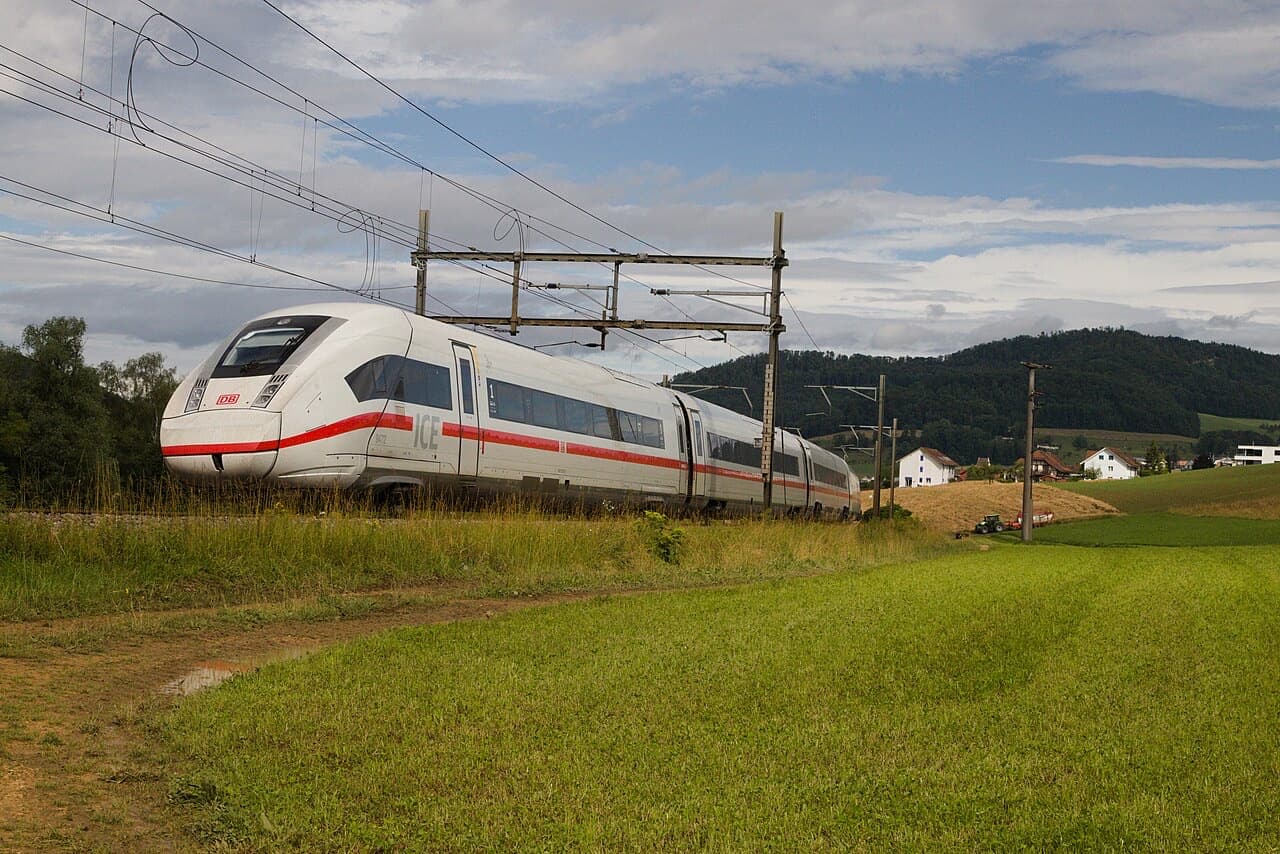
All white with a single red stripe along the sides, a long sloping nose and "ICE" lettered on the side. Single-deck, with no locomotive. The Swiss high-speed look-alikes, Giruno and Astoro, have red noses; the ICE 4's nose is white.
Deutsche Bahn owns 137 ICE 4 sets, all delivered by early 2024, the largest ICE class. In Switzerland it is the usual train on the German through services: Hamburg or Frankfurt–Basel–Zürich–Chur and Berlin–Basel–Bern–Interlaken Ost. One set, presented in Zürich, is named "Zürichsee". Following complaints about the hard seats, DB began reworking the seat cushions in 2020. Since 2024 the existing fleet has been the backbone of DB long-distance traffic rather than a newcomer.
DB started procurement around 2008 to replace its ageing Intercity coaches and the first ICE generation. In 2011 Siemens won the contract for a train then called "ICx", with Bombardier as major partner building car bodies in Wrocław and Graz; in 2013 the order was reshaped around twelve-car sets and the name changed to ICE 4. Trial passenger service began in October 2016 and regular service in December 2017. In 2019 DB halted acceptance over faulty welds on the car bodies, which Siemens repaired over the following years. Swiss approval followed in December 2019 for Basel–Zürich–Chur and in June 2020 for Interlaken.
A twelve-car set is about 346 m long with 830 seats; the thirteen-car version reaches 374 m and 918 seats, the seven-car 202 m and 444 seats. Top speed is 250 km/h for the short sets and 265 km/h for the long ones, though no Swiss line allows more than 200 km/h. It was the first ICE with dedicated bicycle spaces. Passengers note the high capacity and quiet ride; criticism centres on firm seats, a dense seat layout and few seats aligned with windows. In Switzerland it runs Basel–Zürich–Sargans–Chur and Basel–Olten–Bern–Thun–Interlaken Ost.
DB class 412 (powered cars) and 812 (trailers), units 9001–9050, 9201–9237, 9451–9500
German multiple units are numbered by class, not by letters. The ICE 4 carries class 412 on its powered intermediate cars, the "powercars" with four traction motors each, and 812 on everything unpowered: the cab end cars, seating cars and the bistro. The leading 4 marks an electric multiple unit, the 8 its unpowered vehicles — the same pairing as 401/801 on the first ICE. Each train also has a four-digit unit number: 9001–9050 are the twelve-car sets, 9201–9237 the seven-car and 9451–9500 the thirteen-car. A twelve-car set has five powercars spread along the train instead of a locomotive at each end.
DB IC2
Intercity 2 (IC2, Bombardier Twindexx Vario)
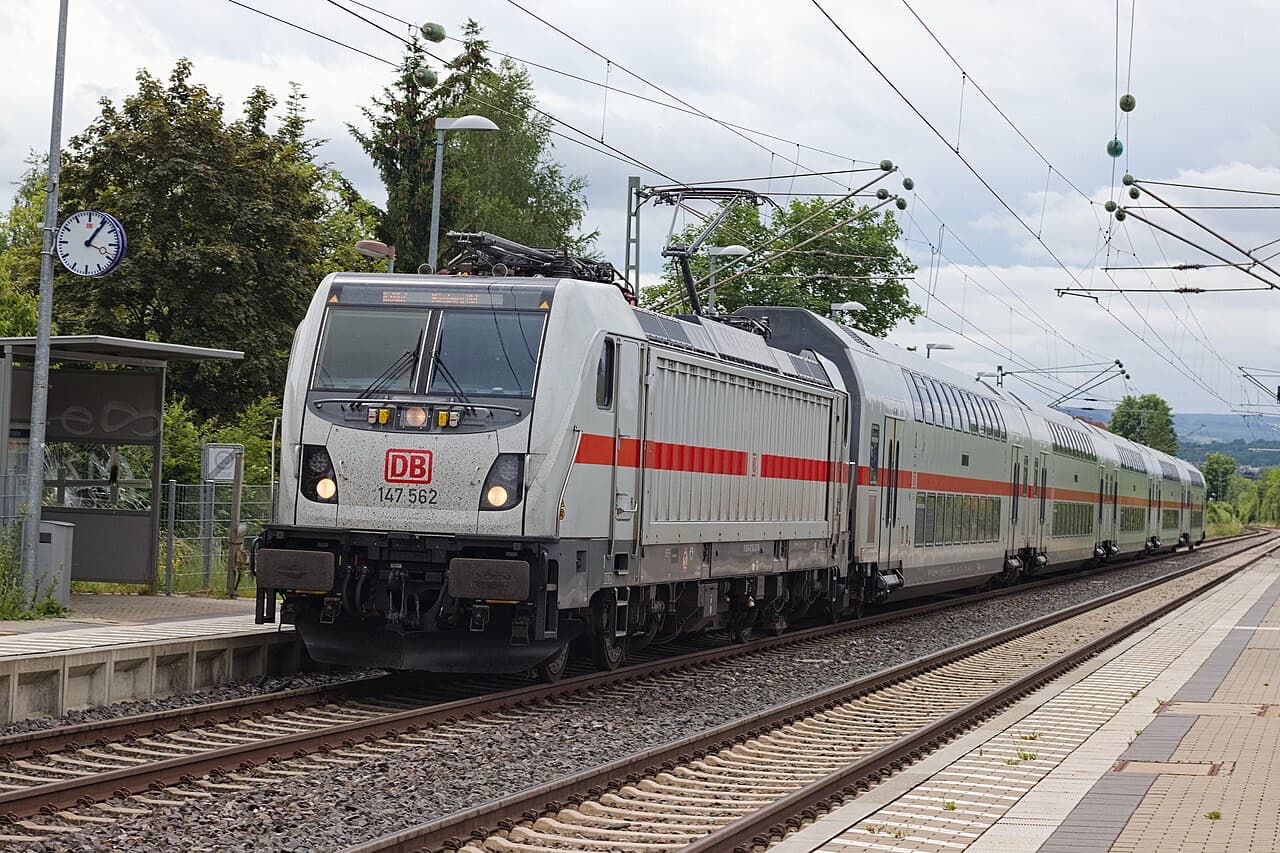
White double-deck coaches with a red stripe, hauled by a separate white DB locomotive with the same stripe. The SBB IC2000, the other locomotive-hauled double-decker, is red and white with a red locomotive.
On the Gäubahn, IC line 87 links Stuttgart with Zürich every hour via Singen and Schaffhausen. Since June 2025 these trains are again IC2 double-deck sets with a class 147.5 locomotive, replacing the six-car Stadler KISS units used since December 2022. Only sets fitted with Swiss train protection and approval can run through; maintenance is done in Basel. Stuttgart 21 construction is to cut the Gäubahn off from Stuttgart Hauptbahnhof, so the trains are planned to start and end at Stuttgart-Vaihingen for several years.
DB ordered 27 IC2 sets with locomotives from Bombardier in 2011, adapting the Twindexx Vario double-deck design from regional traffic to replace older Intercity coaches; further sets followed in 2013 and 2017. The trains entered service in December 2015. The Gäubahn was meant to get through trains to Zürich from 2017, but Bombardier failed to equip the coaches and locomotives for Switzerland in time. DB bridged the gap with Stadler KISS units bought second-hand from Austria. Alstom, which had taken over Bombardier, completed Swiss approval and ETCS testing; trial runs started in March 2025 and the IC2 took over fully that June.
A five-coach set is about 135 m long without locomotive and offers 468 seats, 70 of them in 1st class. Top speed is 160 km/h. There is no bistro or dining car. The trains were criticised early on for little luggage space, firmer seats than older Intercity coaches, door and control faults and a swaying ride on some sections; the 2025 restart was marked by delays on a tight timetable. In Switzerland they run Thayngen–Schaffhausen–Bülach–Zürich HB, crossing the Rhine twice on the way.
DApza 687.2, DBpza 682.2, DBpbzfa 668.2 — hauled by a DB class 147.5
German coach codes stack letters: a leading D marks a double-deck coach, A and B the class. Lower-case letters add features — p an open saloon instead of compartments, z power supplied from the locomotive through the train line, b wheelchair-accessible fittings, f a driving cab for push-pull running. "DBpbzfa" is therefore the accessible 2nd-class control car at the far end, "DApza" the 1st-class coach. The three-digit numbers (687, 682, 668) are DB type numbers, the ".2" the sub-series. The locomotive is a Bombardier Traxx of class 147.5: 1 marks an electric locomotive, 47 its series.
TGV Lyria
TGV Lyria (TGV Euroduplex)
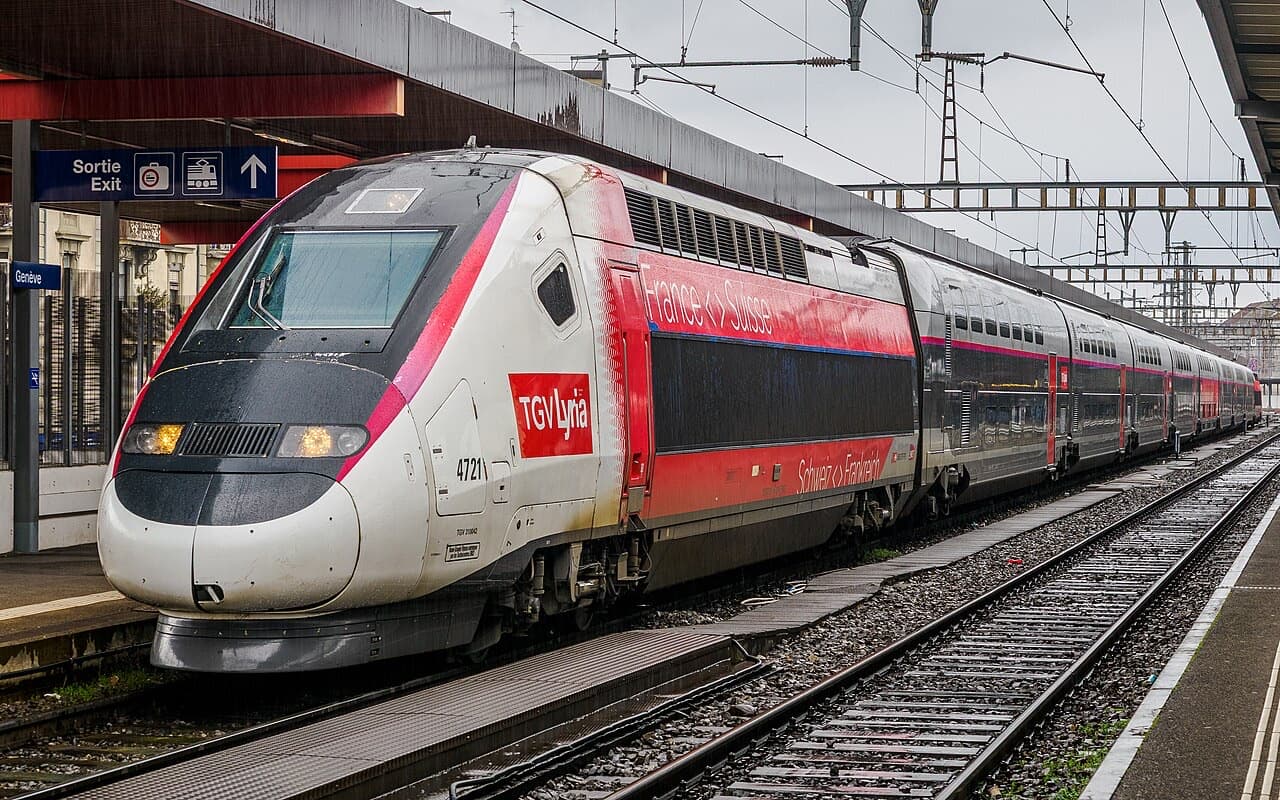
A pointed, rounded nose on a single-deck power car, followed by double-deck coaches, in red and white with the Lyria name on the side.
Lyria, a company owned 74% by SNCF and 26% by SBB, runs all high-speed trains between Paris and Switzerland. Its fleet consists of 15 Euroduplex sets, adapted for Swiss operation. They link Paris-Gare-de-Lyon with Geneva, Lausanne, and Basel and Zürich, with additional seasonal trains to the Alps in winter. Each train offers three classes: Standard, Standard 1ère and Business 1ère, with at-seat meals in Business and a bar on board. Lyria carried around 5.7 million passengers a year in 2024–2025.
Lyria began in 1993 as a joint venture of SNCF and SBB and became a company in 2002. Its trains were single-deck TGVs, most recently 19 TGV POS sets used on the Rhine–Rhône high-speed line, which opened in December 2011 and cut Paris–Zürich to about four hours. To add capacity, Lyria replaced the POS with double-deck Euroduplex sets from Alstom, built at Belfort and Aytré near La Rochelle. The switch took effect with the December 2019 timetable change, and the POS returned to SNCF's domestic fleet.
A set is about 200 m long with 507 seats, built for 320 km/h; on French high-speed lines Lyria runs at up to 300–320 km/h, while under Swiss 15 kV the trains are limited to 160 km/h. Paris–Geneva takes just over three hours. The upper deck offers the better view; the lower deck the step-free access. In Switzerland the trains reach Geneva via Bellegarde, Lausanne, and Basel–Zürich via Mulhouse.
TGV 2N2 (Euroduplex), Lyria sets of SNCF series 4700
A TGV is a fixed set: two power cars at the ends with eight trailers between them, counted as one "rame" with a four-digit set number. "Duplex" means double-deck; "2N2" is SNCF shorthand for its second double-deck generation, "2N" standing for deux niveaux, two levels. The set number reveals the subtype: the 47xx range covers the sets adapted for Switzerland, equipped for three power systems — French 25 kV and 1.5 kV and the 15 kV used in Switzerland and Germany. SBB's formation data tags these sets "(2N2)".
Railjet
Railjet (ÖBB, 1st generation)
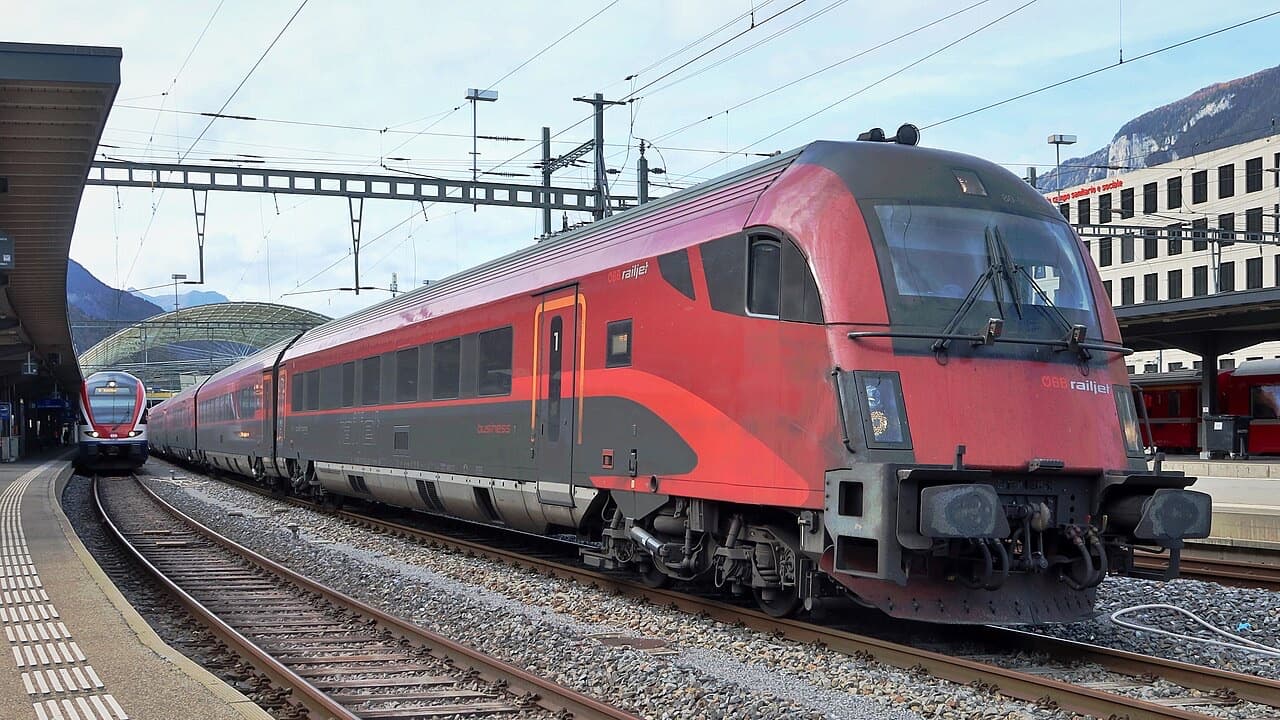
Red and dark grey, with "railjet" lettered on the sides. A locomotive is at one end and a control car at the other, the control car with a rounded red front and a large windscreen.
ÖBB runs 60 Railjet sets, and Czech Railways seven more. From Zürich, Railjets run to Vienna several times a day via Sargans, Buchs SG, Feldkirch, the Arlberg, Innsbruck and Salzburg; individual trains have also served Graz. Since spring 2024 ÖBB has been refurbishing the first generation to match the interior of the Railjet 2nd generation, delivered from 2024; the work is scheduled to run until 2031. Each set carries three classes: Business, First and Economy.
ÖBB ordered 23 Railjets from Siemens in February 2006 with an option for more, and added 44 in 2007, though not all were taken. The first set left Siemens' Vienna works in April 2008; regular service started with the December 2008 timetable on Vienna–Salzburg routes. Zürich gained a Railjet to Vienna in December 2009, with more following in later timetables. Sets 01–51 were delivered by 2012; sets 52–60, with a revised interior and more seats, followed in 2015–2016. Czech Railways ordered seven sets in 2012 for Prague–Vienna–Graz.
A seven-coach set is about 186 m long without locomotive and seats 404 (sets 01–51) or 442 (sets 52–60). Top speed is 230 km/h, which on the Swiss and Arlberg sections is never reached; Zürich–Vienna takes about eight hours. Business class sits in the control car at the train's end. A full restaurant section and a Business class with leather seats set it apart from other Swiss–Austrian trains. In Switzerland the trains run Zürich–Thalwil–Sargans–Buchs SG, along Lake Zurich and the Walensee.
Afmpz, ARbmpz, Ampz, Bmpz, Bmpvz — hauled by an ÖBB Taurus 1116 or 1216
ÖBB coach codes follow the UIC letter scheme. A is 1st class, B 2nd, R a restaurant section. The lower-case letters describe the build: m a coach over 24 m long, p an open saloon, z power supplied from the locomotive through the train line, b wheelchair-accessible fittings, v bicycle spaces, f a driving cab for push-pull running. "Afmpz" is therefore the control car with Business and 1st class, "ARbmpz" the 1st-class coach with the restaurant. The locomotives are Siemens Taurus engines: ÖBB class 1116 runs on two power systems, the 1216 on four.
Régiolis
Régiolis (Léman Express)
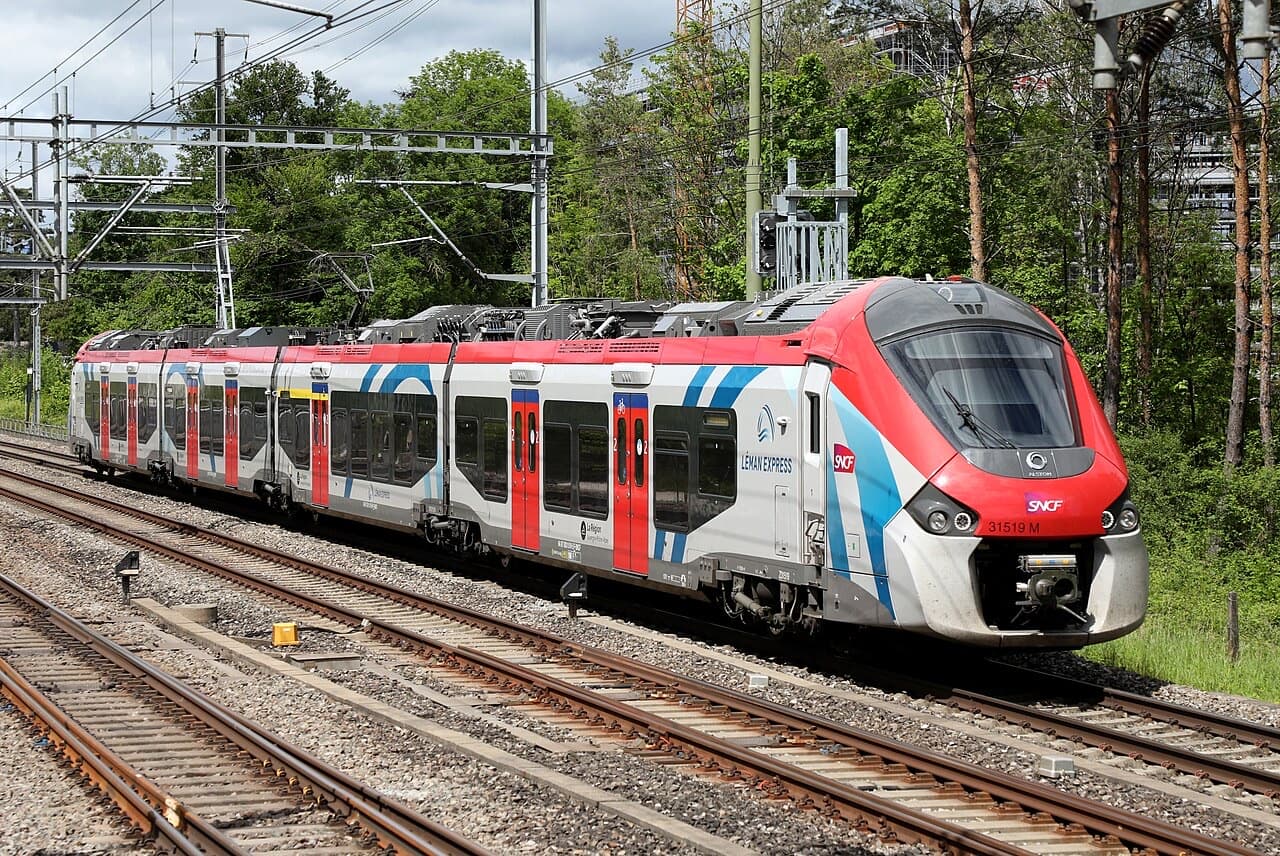
A single-deck unit with a rounded, bulging nose, in white with a red front and blue swooshes in Léman Express livery, carrying the SNCF logo. The Léman Express FLIRTs run in the same livery but carry SBB logos.
SNCF operates 27 Z 31500 units for the Auvergne-Rhône-Alpes region, which owns them. They share the cross-border Léman Express with SBB's Flirt units (RABe 522). The network carries about 92,000 passengers a day. The trains run from Coppet through Geneva to Annemasse and on to Thonon-les-Bains, Évian-les-Bains or Saint-Gervais-les-Bains-Le Fayet; some units also run regular TER services within France.
SNCF launched a tender for a modular regional train in the 2000s and signed a framework contract with Alstom in 2009. The Régiolis entered service in April 2014, more than a year late, and is now owned by CAF following Alstom's takeover of Bombardier. For the Léman Express, Auvergne-Rhône-Alpes first ordered 17 three-voltage units; the first was presented in April 2019 and deliveries ran from August 2019 to June 2021. The network opened fully on 15 December 2019 with the CEVA tunnel line between Geneva Cornavin and Annemasse. Early operation was marked by delays and poor real-time information.
A four-car unit is 72 m long with about 220 seats and rests on five bogies. Top speed is 160 km/h, limited to 140 km/h on the Léman Express. The units were the first Régiolis with ETCS cab signalling, needed on the Swiss section, and have a larger transformer for the third voltage. Seating is mostly 2+2 in groups of four with reading lights; sockets are French only. In Switzerland they run Coppet–Geneva Cornavin–Lancy-Pont-Rouge–Eaux-Vives–Chêne-Bourg into France.
SNCF Z 31500 (Z 31501/02 – Z 31553/54)
SNCF classes start with a letter for the vehicle type: Z for an electric multiple unit, X for diesel, B for bi-mode. The five-digit number gives the series; 31500 marks the Léman Express subtype of the Régiolis. Each unit carries two numbers, one for each cab end, so the first is "Z 31501/02". Régiolis is SNCF's brand name for the Alstom Coradia Polyvalent; the "Z" sets run on electricity only, here on three systems — French 25 kV and 1.5 kV and the Swiss 15 kV.
GoldenPass Express
GoldenPass Express (GPX)
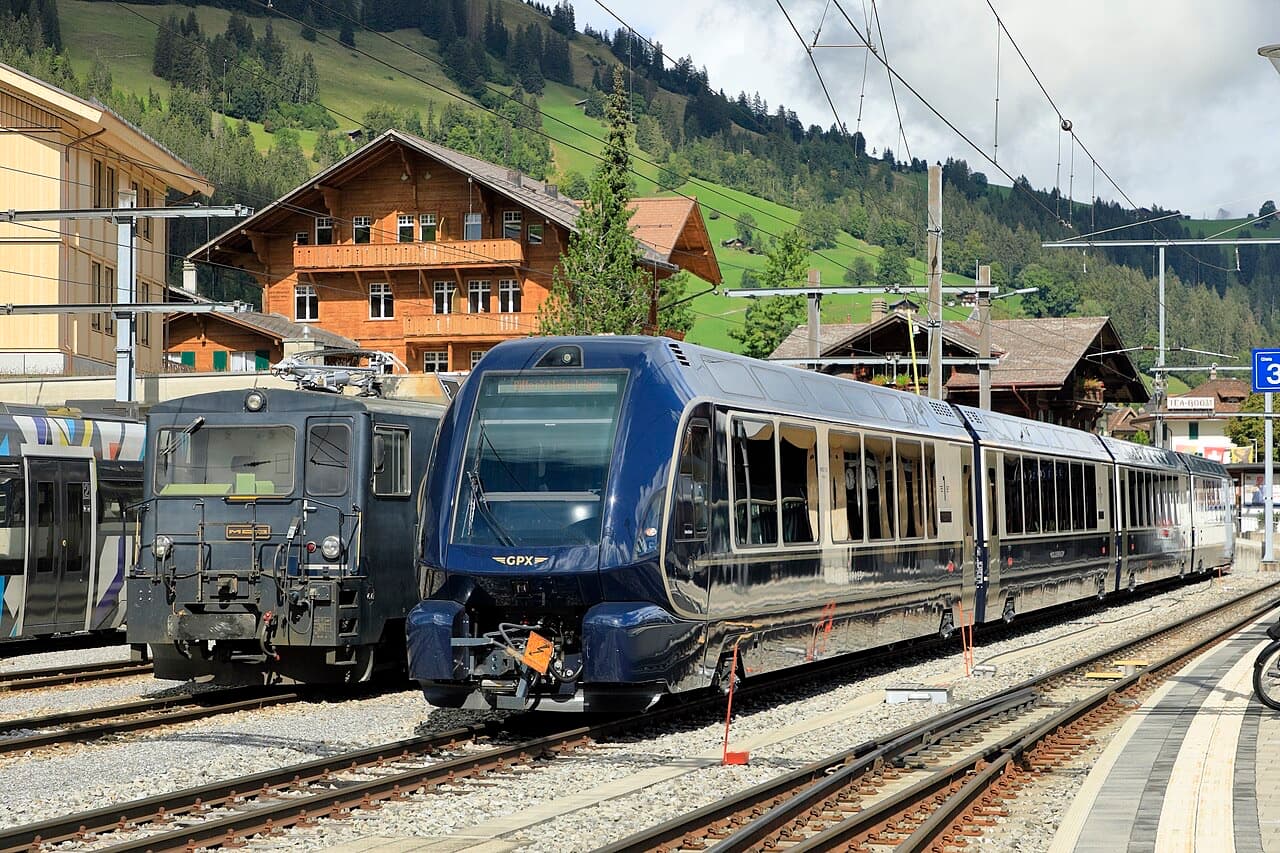
A dark-blue metre-gauge train with "GPX" on the front, its large panoramic windows reaching up into the roof.
The GoldenPass Express runs between Montreux and Interlaken Ost without a change of train, something the different track gauges ruled out for more than a century. MOB (Montreux Oberland Bernois) runs the metre-gauge part to Zweisimmen, BLS the standard-gauge part via Spiez. At Zweisimmen the coaches roll through a gauge-changing installation while the locomotives are swapped: a MOB Ge 4/4 on one side, a BLS Re 465 on the other. Several round trips run daily in three classes — 2nd, 1st and Prestige, the latter with raised seats at the ends of the train for a supplement. Since May 2024 low-floor Bs cars add step-free access.
Through trains from Lake Geneva to the Bernese Oberland were discussed from the line's early days, but switching between 1000 mm and 1435 mm track needed a bogie that could change gauge and ride height on the move. MOB started development around 2008; a prototype EV09 bogie was tested from 2010. In 2018 MOB ordered 20 coaches from Stadler, mounted on Alstom EV18 bogies built in Salzgitter. Planned for 2019 and then 2020, the launch slipped to 11 December 2022 — described as the first automatic gauge change of its kind. In early 2023 standard-gauge points were damaged, the wheel back-to-back distance was corrected by a few millimetres, and through running resumed in June 2023.
A GPX has five to six coaches; the investment, including the bogies and the Zweisimmen installation, came to about CHF 89 million. Each EV18 bogie weighs close to four tonnes and also lifts the coach floor from 350 mm metre-gauge platforms to 550 mm standard-gauge ones. The coach bodies weigh over 20 tonnes each so that they meet standard-gauge crash rules. Prestige seats sit nine to a control car, 1st-class As cars carry 28 seats and 2nd-class Bs cars 54. The route runs through Montbovon, Château-d'Œx, Gstaad and Zweisimmen, then along the Simmental and Lake Thun to Interlaken, taking about three hours and a quarter. The early months brought cancellations while the bogies and points were adjusted.
Ast, As, Bs, ABst, Bsi — MOB coaches on gauge-changing bogies; Ge 4/4 (MOB) and Re 465 (BLS) locomotives
The coach codes follow the Swiss pattern: A is 1st class, B 2nd, AB both, and t a driving cab, so Ast and ABst are the control cars at either end. The lowercase s stands for Salonwagen — MOB uses it for its saloon-style panorama coaches. Bsi marks the extra 2nd-class "interface" cars that only run on the standard-gauge section. The locomotives read differently: Ge 4/4 is a narrow-gauge (G) electric (e) locomotive with four of four axles driven; Re 465 is BLS's standard-gauge locomotive faster than 110 km/h (R), electric (e), series 465. In SBB's formation data the coaches simply carry the tag "MOB GPE".
Gotthard Panorama Express
Gotthard Panorama Express
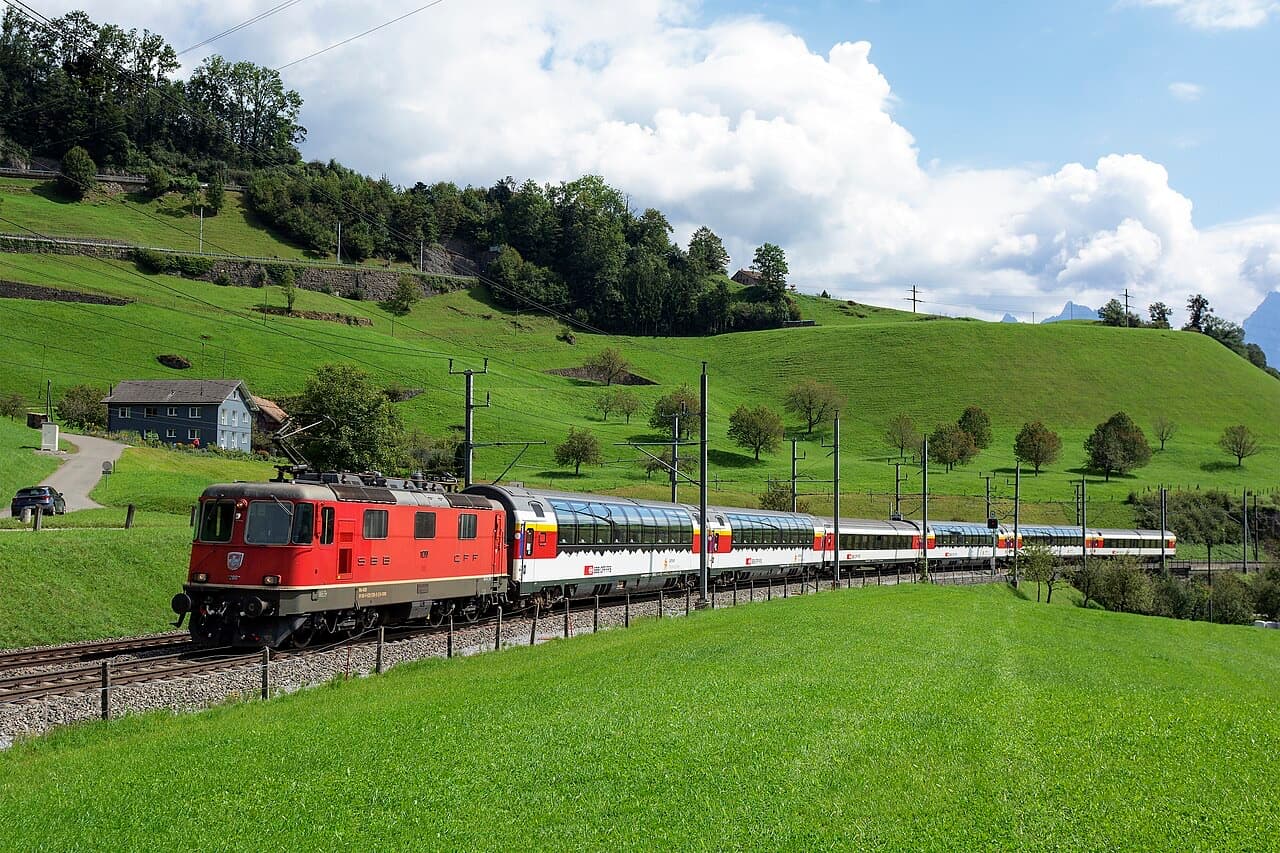
Single-deck coaches whose windows curve up into the roof, so the upper half of each car is almost all glass, in a rake of ordinary white EuroCity coaches behind a red locomotive with a boxy, flat front. The regular coaches in the same rake have flat roofs and a single band of windows.
The Gotthard Panorama Express is a seasonal SBB excursion that pairs a boat with a train: a paddle steamer or motor ship of the Lake Lucerne Navigation Company between Lucerne and Flüelen, and a panorama train between Flüelen and Lugano over the 1882 Gotthard mountain line. It runs once a day in each direction from mid-April to mid-October, except on Mondays. Since 2019 it is 1st class only and seat reservation is compulsory. The train has four panorama coaches and a photo coach in the middle, open to every passenger; food is served at the seat, and the full meals are on the boat.
When the Gotthard Base Tunnel opened in 2016, long-distance trains left the old line through Wassen and Airolo, freeing paths for tourist traffic. SBB used them to replace the William Tell Express, which had combined the boat with ordinary InterRegio trains, with a dedicated service launched in 2017. Its core is the SBB panorama coaches: twelve 1st-class Apm built in 1991–1992 on the basis of the EuroCity coaches, with Schindler Waggon building the bodies, SIG the bogies and ABB the electrics. Before the Gotthard Panorama Express they ran in international trains and charters; they remain SBB's only standard-gauge panorama coaches.
The panorama coaches are about 26 m long, run at up to 200 km/h and seat 54 each — six fewer than a regular EuroCity coach, because nine curved windows on each side reach into the roof and the raised floor needs ramps at the doors. The train portion of the trip takes around two and a half hours and the whole journey about five and a half. Highlights are the loops around Wassen, whose church appears three times, the Leventina spirals and the descent to Bellinzona; on the lake, the Rütli meadow and the Tell Chapel. Spare panorama coaches also turn up in other SBB trains and charters.
Apm 61 panorama coaches, Bpm 51 photo coach ("Escher"), hauled by an Re 420
In the coach codes, A is 1st class and B 2nd; the lowercase p marks an open-plan coach with a centre aisle, m one longer than 24 m. The digits come from the 12-digit UIC number: 61 is an air-conditioned coach approved for international traffic, 51 one without air-conditioning — which suits the photo coach, whose windows open. That coach carries a statue of Alfred Escher, the politician who pushed the Gotthard railway through, and appears in SBB's formation data as "Escher". The locomotive is an Re 420: R for faster than 110 km/h, e electric, series 420 (the former Re 4/4 II, four of four axles driven).
Nightjet
ÖBB Nightjet
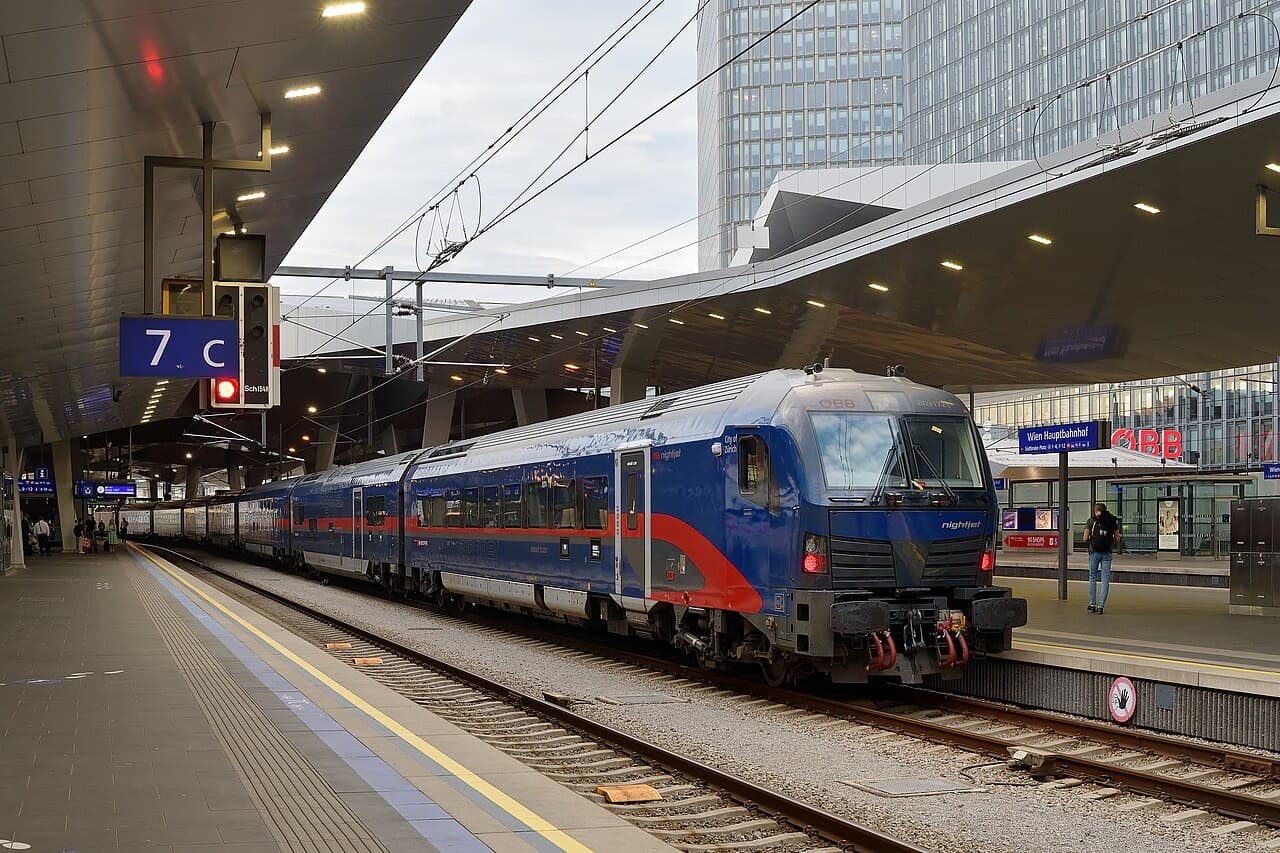
Dark-blue coaches with a thin red line along the side, behind a locomotive.
Nightjet is the night-train brand of the Austrian Federal Railways (ÖBB), which runs the Swiss lines together with SBB. In 2026 Nightjets link Zürich with Hamburg, Berlin, Amsterdam, Vienna and Graz; the trains to Germany and the Netherlands also stop in Basel. New-generation sets have run Zürich–Hamburg since 4 December 2025 — the first named "City of Zurich" — and Zürich–Vienna since 15 June 2026; Zürich–Amsterdam is planned to follow with the December 2026 timetable. Elsewhere the older sleepers and couchettes remain, often coupled with SBB or DB seat coaches.
When Deutsche Bahn gave up its City Night Line network, ÖBB took over many of its routes and launched Nightjet on 11 December 2016, buying used DB coaches to fill the gap. The 42 sleepers came from Siemens SGP (2003–2005); the couchette cars date from several series between 1981 and 2001, many later refurbished with air-conditioning. In 2018 ÖBB ordered 13 new trains from Siemens, a further batch followed in 2021; deliveries began in 2023, with the first entering service on Hamburg–Vienna/Innsbruck that December. The order was later scaled back, to 24 sets in total as of July 2025.
A new-generation set has seven cars for about 260 travellers: two sleeper cars with private shower and toilet, three couchette cars including "mini cabins" — single-person sleeping pods — one multifunction car and a control car with 70 seats; top speed is 230 km/h. The older sleepers offer 12 compartments, three with en-suite bathrooms, and run at up to 200 km/h. Inside Switzerland the trains use the Basel–Zürich and Zürich–Buchs SG lines; most of the night is spent abroad. Criticism has centred on reliability: cancellations, delays and passengers moved from booked sleepers to seats when coaches were missing, notably in 2023.
WLABmz / WLAmz sleeper cars, Bcmz couchette cars, Bmz seat cars; new generation: Siemens Viaggio Next Level sets
Nightjet coaches use the UIC letters common across Europe. W marks a special car and L a sleeper (WL), followed by the classes it offers: WLAB has 1st- and 2nd-class sleeping compartments. B is 2nd class, c adds couchettes — seats that convert into berths. The lowercase m means a coach longer than about 24 m, and z one powered only from the train's supply line. Coach numbers starting "61 81" show an international coach (61) owned by Austria (81). The new-generation trains are seven-car Siemens Viaggio Next Level sets, built as fixed formations rather than single coaches.
EuroCity
SBB EuroCity coaches (EC-Wagen)
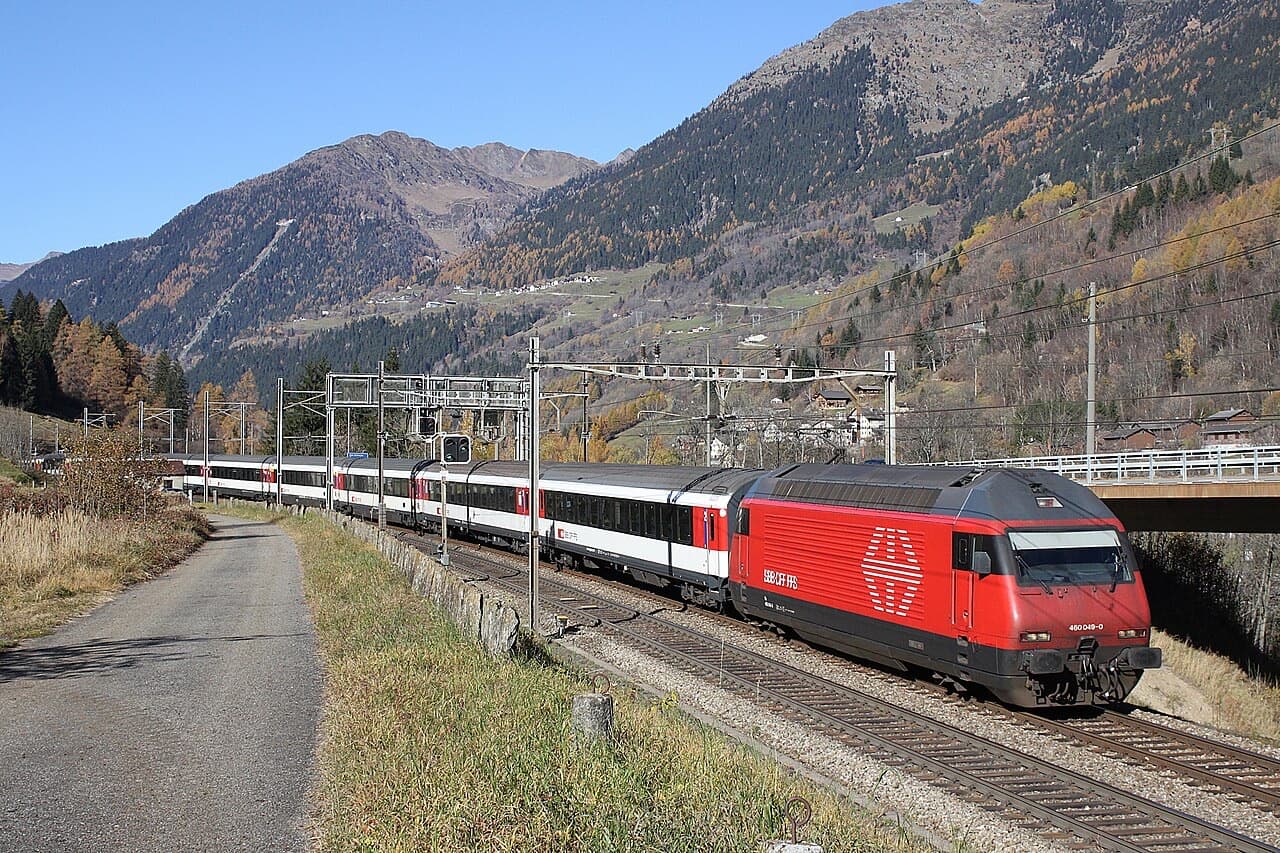
Long single-deck coaches in white with a dark band at window height, hauled by a red Re 460 locomotive with a rounded nose. The separate locomotive sets it apart from the Giruno and Astoro, fixed sets with pointed noses at both ends.
The EuroCity coaches are SBB's main fleet of single-deck, locomotive-hauled long-distance coaches, typically pushed or pulled by an Re 460. With Giruno, Astoro and other multiple units taking over most international trains, they now mostly run in domestic InterCity and InterRegio services, on lines where double-deck IC2000 coaches don't fit or aren't needed, and in relief trains. They also appear in some international EuroCity and night-train formations. Since about 2021 they have been repainted with red doors, matching the refreshed EW IV coaches.
Between 1989 and 1995 SBB took delivery of a large series of air-conditioned coaches for the then-new EuroCity network: 70 Apm and 155 Bpm, plus restaurant cars. The design drew on the Bpm RIC coaches of 1980 and the EW IV; the roof shape followed the French Corail coaches. A batch (Apm 251–260, Bpm 309–328) was painted for Cisalpino services to Italy but stayed SBB property. In 2008–2009 SBB approved a CHF 137 million refit: closed toilets, laptop and phone sockets, push-pull capability and a repaint matching the EW IV. The twelve Apm panorama coaches, now used in the Gotthard Panorama Express, were derived from the same design.
The coaches are 26.4 m long, built to the UIC-Z1 standard and approved for 200 km/h. Both classes use the same body, with ten windows between end doors; 1st-class Apm seat 60 and 2nd-class Bpm about 80, in an open layout. Some Bpm have bike spaces and run on the Gotthard routes. Multi-voltage equipment kept through the refit lets them run into Germany, Austria and Italy. Unlike newer multiple units, they have no level boarding: passengers climb steps at the end doors.
Apm 61, Bpm 61, WRm 61
A is 1st class, B 2nd; WR is a restaurant car (W special car, R restaurant). The lowercase p marks an open-plan coach with a centre aisle rather than compartments, and m one longer than 24 m — these measure 26.4 m. The 61 is the start of the 12-digit UIC number and marks an air-conditioned coach approved for international (RIC) traffic, so the coaches can cross borders without restriction. SBB's formation data adds a bracketed variant tag, such as "Apm61(GBT)" or "Bpm61(ERA)", to tell versions with different fittings apart.
NPZ
NPZ (Neuer Pendelzug), nicknamed "Kolibri"
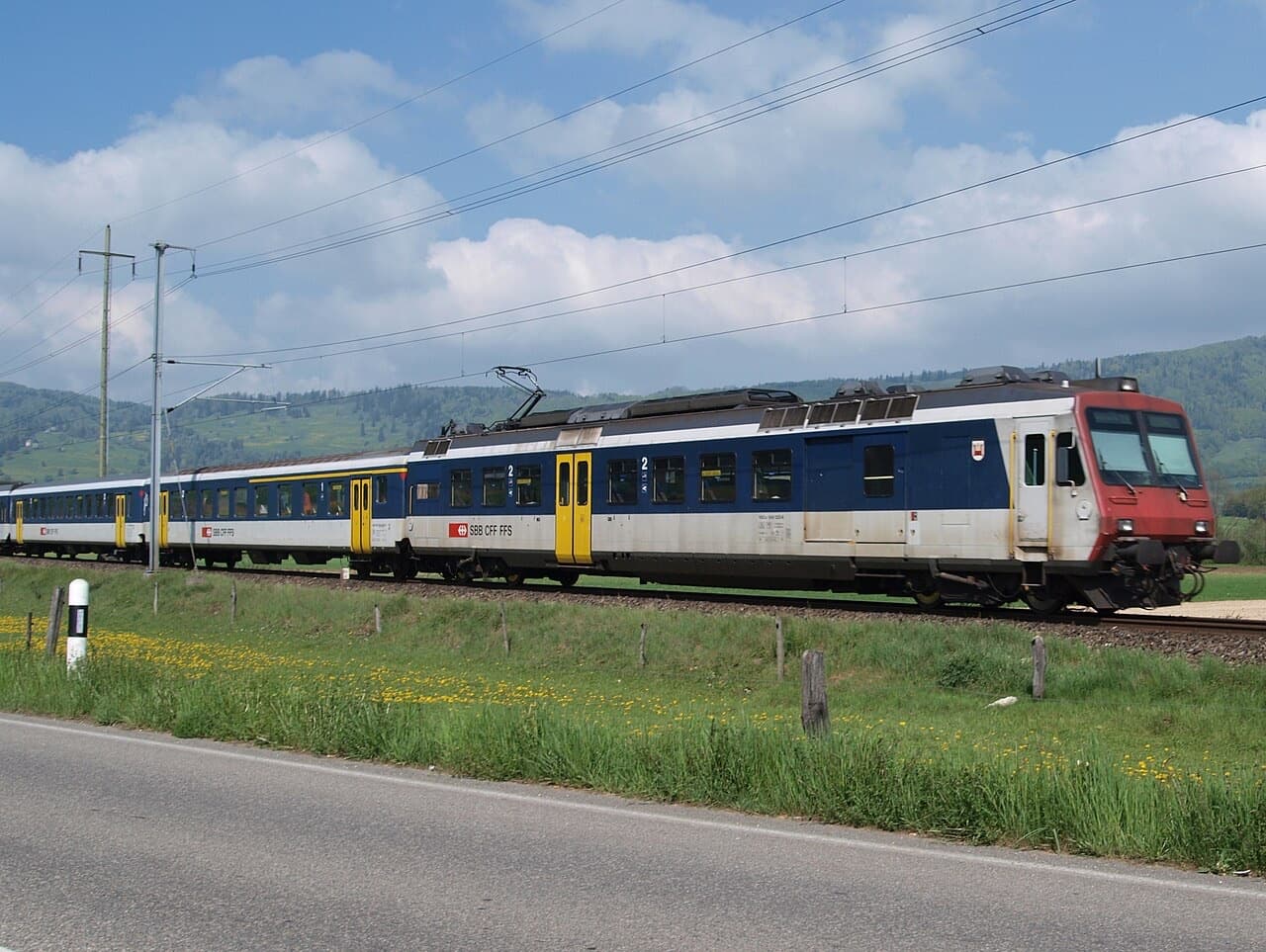
A boxy motor car with a red, near-upright cab front, dark-blue and white sides, yellow doors and steps up into them, followed by older single-deck coaches in the same colours. The Domino, its refurbished form, has the same box shape in white with a red front and red doors.
The NPZ in its original form has almost vanished. SBB rebuilt 120 of its sets into the Domino between 2008 and 2013; the four prototypes were sold to small railways in 2007–2008, and the six dual-voltage RBDe 562 sets, never modernised because France would have required a fresh approval, lost their licence at the end of 2019 and were scrapped by December 2020. Private-railway sets have largely gone too: the SOB's after 2019, the Montafonerbahn's in 2020. The motor cars themselves live on inside Domino trains, including those operated by TPF around Fribourg.
In the early 1980s SBB wanted a standard push-pull train to replace older regional stock. Four prototypes arrived in 1984 as RBDe 4/4 2100–2103, built by a group of Swiss firms including FFA, SIG, Schindler and BBC. A first series followed in 1987–1990, with a second batch of 42 in 1994–1996; private railways such as the Südostbahn, Mittelthurgaubahn and Pont–Brassus bought near-identical sets. Their blue, white, yellow and red livery stood out so sharply against the green of older SBB stock that the trains were soon called "Kolibri" (hummingbird). Most sets received names of towns along their routes.
A motor car is 25 m long, weighs about 70 t, delivers 1,650 kW and reaches 140 km/h; it carries 56 2nd-class seats plus a luggage area. Between motor and control car ran refurbished older coaches of the EW I and EW II types, which meant high steps and no air conditioning. Sets could run in multiple, which made them flexible on S-Bahn networks around Zürich, Bern and Basel and on regional lines across the Mittelland, Jura and Romandie. The RBDe 562 version linked Basel with Mulhouse and later ran Neuchâtel–Frasne services into France until 2019.
RBDe 560 motor car (originally RBDe 4/4) + middle coaches + Bt control car
R marks a motor vehicle built for more than 110 km/h, B that it carries 2nd-class seats, D a luggage compartment, e electric traction. The original "4/4" meant four driven axles out of four, in a Bo'Bo' layout: two bogies with two motored axles each. Under the newer numbering the motor cars became RBDe 560 — 5xx is the range for standard-gauge railcars and multiple units — with variants such as 561 (Basel/Germany), 562 (dual-voltage for France) and 566/568 for private railways. The control car at the other end is a Bt: B for 2nd class, t for the driving cab.
Domino
Domino (modernised NPZ)
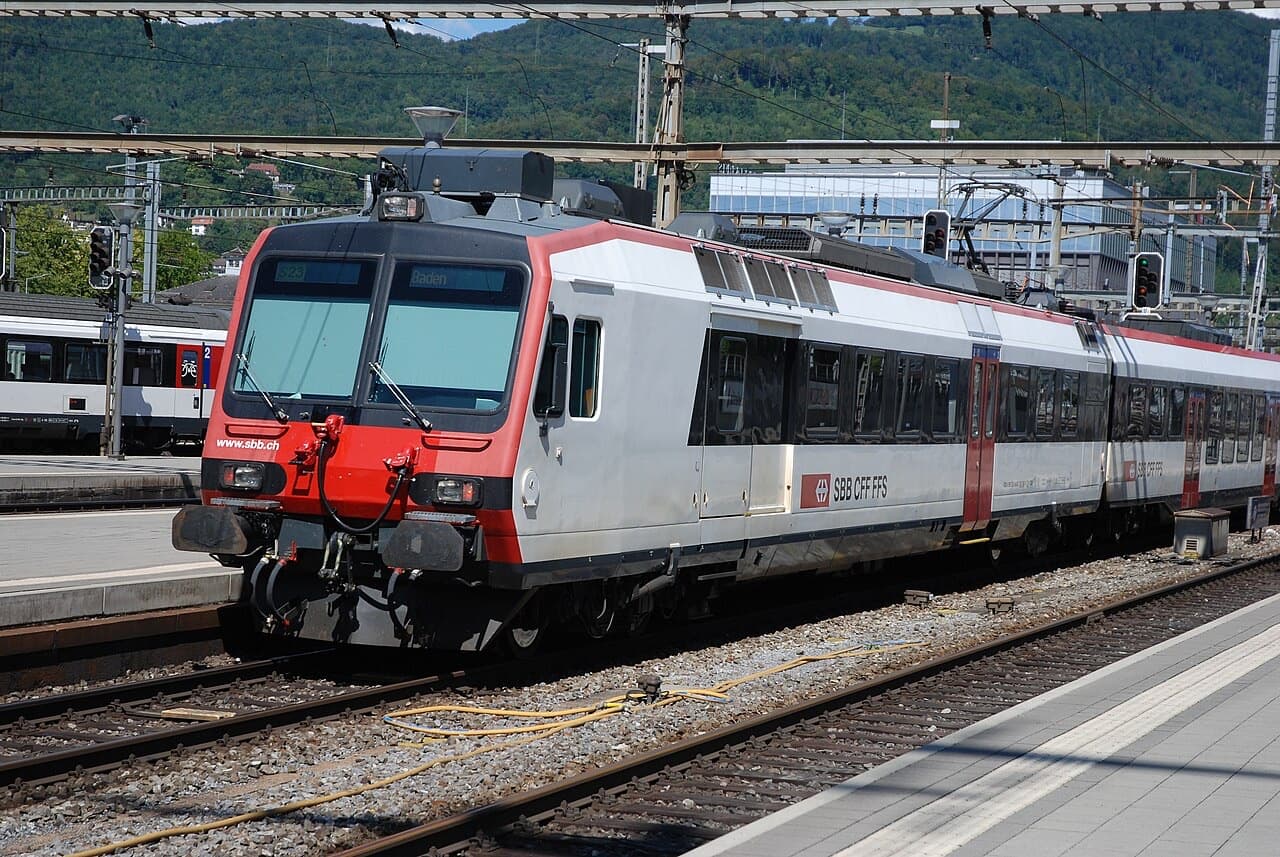
A boxy single-deck set in white with a red front and red doors: a motor car, a coach and a control car with the same blunt, near-upright cab. The NPZ it was rebuilt from has the same shape in dark blue and white with yellow doors.
Domino trains still run regional services in many parts of Switzerland in 2026, as three- or four-car sets that can be coupled in multiple. TPF in Fribourg took over ex-SBB sets from December 2021 and ran 14 three-car units by 2023; RegionAlps uses them in Valais. Their end is scheduled: SBB, Thurbo and RegionAlps ordered 286 single-deck FLIRT Evo trains from Stadler for about CHF 2 billion, with deliveries from December 2025, and expect to retire the Domino by around 2034.
By the mid-2000s the NPZ motor cars were sound, but their old middle coaches were not: high steps, no air conditioning, and coaches over 40 years old. In 2006 SBB launched a modernisation programme for 120 sets. Motor and control cars were rebuilt with air conditioning, updated safety systems and a new train-control interface, while Bombardier in Villeneuve built new low-floor middle coaches of its INOVA design. The first Domino entered service in 2009 and the programme was completed on schedule in 2013. Two sets of the Pont–Brassus railway (later Travys) were converted in 2009 and sold to SBB in 2022.
A three-car Domino is about 75 m long and runs at up to 140 km/h; up to three sets can be coupled. The low-floor middle coach gives step-free access for wheelchairs, prams and bikes, while the motor car and control car keep their high floors and steps. The 1st-class compartment sits in the control car, behind the cab. Dominos appear on S-Bahn and regional lines around Bern, Basel and Zürich — including the Glarner Sprinter to Linthal — as well as in Valais and around Fribourg. Next to newer FLIRT and KISS trains they look dated, chiefly because only the middle coach offers level boarding.
RBDe 560 + B or AB low-floor middle coach(es) + ABt
The motor car keeps its NPZ code: R for a vehicle faster than 110 km/h, B for 2nd class, D for a luggage compartment, e for electric, 560 for the series within the 5xx range of standard-gauge railcars. The modernisation moved 1st class into the control car, so it changed from Bt to ABt — A and B for both classes, t for the driving cab. The new middle coaches are B (2nd class only) or AB (both classes); they have a low-floor section in the middle for step-free boarding.
DPZ
DPZ (Doppelstock-Pendelzug), since refurbishment "DPZ Plus"
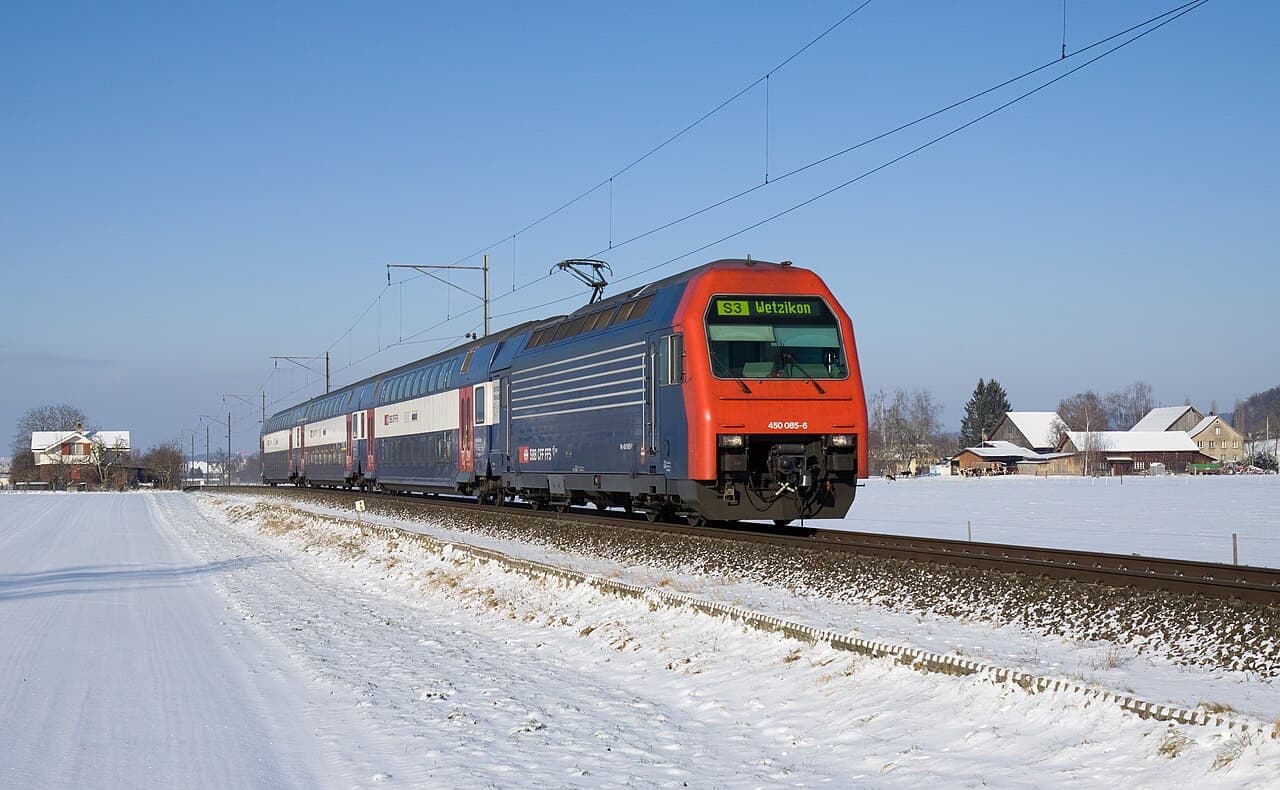
Double-deck S-Bahn coaches pushed or pulled by a separate locomotive with a single cab and a flat, red front; at the other end is a double-deck control car. The DTZ, KISS and MUTZ are fixed double-deck units with rounded noses at both ends and no locomotive.
The DPZ is still the backbone of the Zürich S-Bahn: SBB lists 113 sets, which run on most lines of the ZVV network. Between 2011 and 2018 all of them were refurbished as DPZ Plus for about CHF 600 million, with air conditioning, new interiors, passenger information screens and a new low-floor coach in each set. In November 2025 SBB ordered 116 double-deck trains from Siemens Mobility; the contract became final in April 2026 after Stadler withdrew its appeal. The 95 trains intended for Zürich are to replace the DPZ from 2031.
The DPZ was built for the Zürich S-Bahn, which opened in May 1990. SBB chose locomotive-hauled push-pull trains with three double-deck coaches; 115 Re 450 locomotives came from SLM and ABB between 1989 and 1997, the coaches from Schindler Waggon with SIG bogies, with deliveries running until 1998. In 2008 SBB and the SZU ordered 121 low-floor double-deck coaches from a Siemens–Bombardier consortium for CHF 324 million, built in Vienna and Villeneuve; 113 went into the DPZ, replacing one original coach per set. SBB workshops in Yverdon, Bellinzona and Olten carried out the refurbishment.
A set is 98.8 m long, reaches 130 km/h and seats 345 according to SBB. The Re 450 delivers 3,200 kW and was the first large SBB series with three-phase asynchronous motors controlled by GTO thyristors. The NDW coach offers level boarding for wheelchairs, prams and walkers; the original coaches have steps at the doors. Livery changes in the refurbishment replaced the yellow doors with red ones and the locomotives became dark blue. The trains run almost exclusively within the Zürich S-Bahn network.
Re 450 + AB + B-NDW + Bt
The locomotive is an Re 450: R for a top speed above 110 km/h, e for electric, 450 for the series in the 4xx locomotive range; it rides on two bogies with two motored axles each (Bo'Bo'). The double-deck coaches follow the usual class letters — AB carries both 1st and 2nd class, B only 2nd — and the Bt is the 2nd-class control car with a driving cab (t). NDW stands for Niederflur-Doppelstockwagen, the low-floor double-deck coach added during the refurbishment.
KISS
KISS (Stadler), at SBB formerly "Regio-Dosto" and "IR-Dosto"
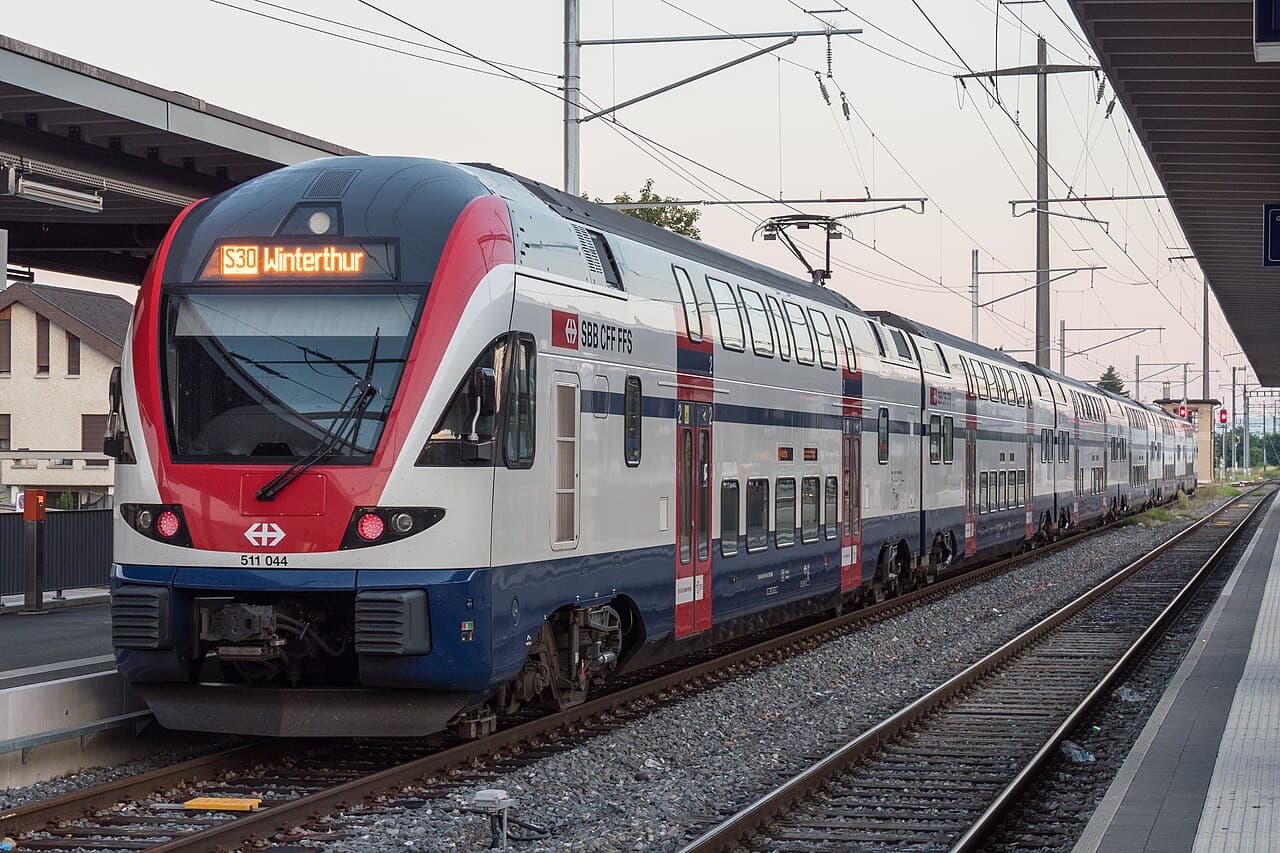
A white double-deck unit with a rounded nose that curves up into the roof, framed by a red band, and a dark-blue lower body. Its doors sit low between the bogies, at the height of the lower deck. The DTZ shares the colours but has a flatter, more upright front; BLS's MUTZ has the KISS shape in silver and green.
SBB runs 93 RABe 511 — 69 six-car and 24 four-car units — and 60 RABe 512, the last of which Stadler delivered on 2 October 2026. The 511s serve the Zürich S-Bahn and RegioExpress lines; between 2020 and 2024, 43 of them were converted into "IR-Dosto" units for Interregio and RegioExpress work, with sockets in 2nd class and 2+1 seating in 1st. The 512s run IR and RE services around Zürich, across the Mittelland and in western Switzerland.
On 27 June 2008 SBB ordered 50 six-car double-deck trains from Stadler Rail for the second stage of the Zürich S-Bahn. The order was extended in April 2010 with 24 four-car units for RegioExpress lines, and in 2015 with 19 more six-car trains. The first unit was presented at Zürich HB on 3 June 2010; six-car trains followed in 2010–2012, four-car units in 2015–2016. In April 2021 SBB ordered 60 further-developed trains for about CHF 1.3 billion; the first RABe 512 entered passenger service on 17 July 2023 as RE48 Zürich–Schaffhausen.
A six-car RABe 511 is 150 m long, seats 535 (120 1st, 415 2nd) and reaches 160 km/h; the four-car version is about 100 m long with 337 seats. Peak power is 6,000 kW, which gives the quick acceleration the name refers to. A RABe 512 is about 152 m long with 466 seats (94 1st, 372 2nd). The low-floor entrances sit between the decks, so passengers board level and climb short stairs to either floor. Typical routes include Zürich S-Bahn lines such as S3, S5 and S8, RE services Zürich–Schaffhausen, St. Gallen–Chur, Basel–Zürich and Bern–Biel, and Geneva–Vevey on Lake Geneva.
RABe 511 (six- and four-car), RABe 512 (six-car)
RABe describes a multiple unit with its own traction: R for a top speed above 110 km/h, A and B for 1st- and 2nd-class seats, e for electric. 511 and 512 are series numbers within the 5xx range for standard-gauge multiple units; 512 marks the later, revised Interregio version. Stadler first sold the train as "DOSTO" and has branded it KISS since 2010, short for "komfortabler innovativer spurtstarker S-Bahn-Zug" (comfortable, innovative, sprint-capable suburban train). Only the end cars are powered, each riding on two motored bogies.
DTZ
DTZ (Doppelstock-Triebzug), Siemens Desiro Double Deck
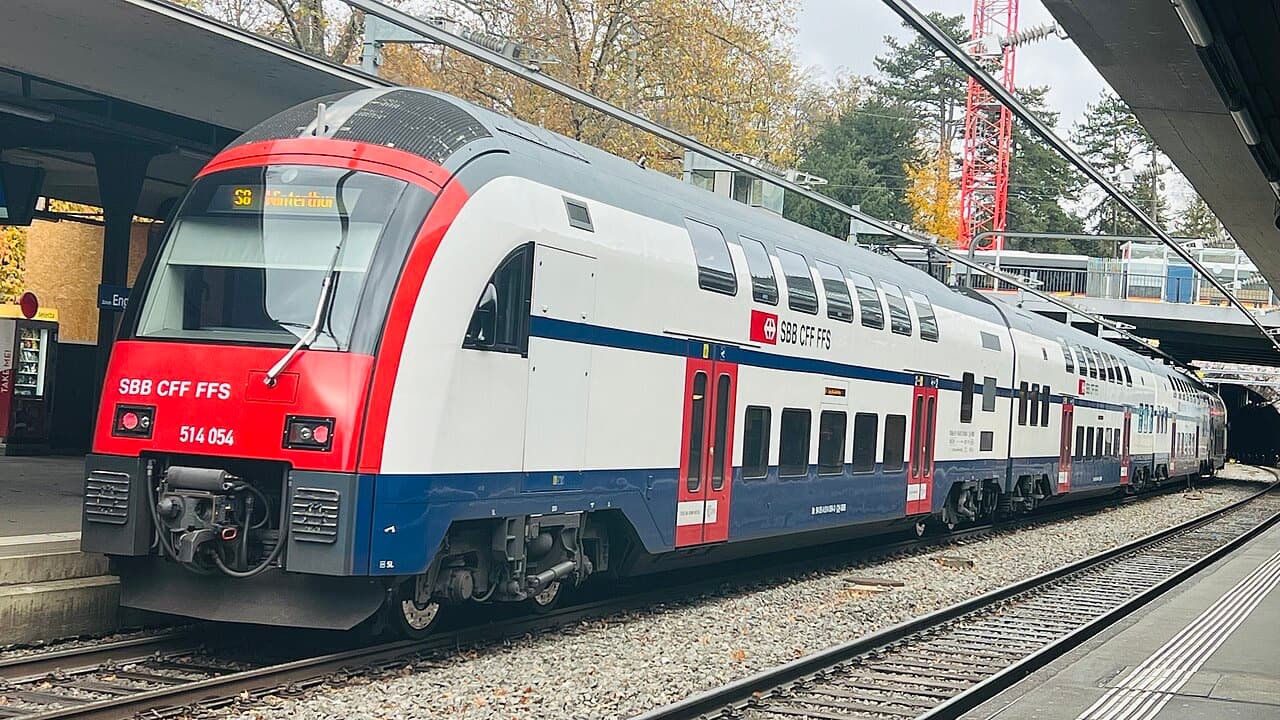
A double-deck unit in white with a dark-blue lower body and a red front, a red arch over a large, near-vertical windscreen. Next to the KISS the front is flatter and taller; the KISS nose is rounder and slopes back.
The 61 DTZ form the second generation of the Zürich S-Bahn and still run there in 2026. They are currently going through a mid-life refit at SBB's works in Olten, where the car bodies are repaired, sandblasted and repainted; the first refitted unit, 514 011 "Wipkingen", returned with more conspicuous doors among other changes. SBB describes the work as a half-life overhaul, so the DTZ is set to keep running alongside the KISS and, from 2031, the new Siemens double-deck trains ordered to replace the DPZ.
SBB awarded the contract to Siemens Transportation Systems in February 2003; the first 35 units were worth CHF 447 million. Car bodies came from Siemens' plant in Prague, the end cars were assembled in Krefeld-Uerdingen and Stadler fitted out the middle cars in Altenrhein. Production capacity in Prague and air-conditioning problems delayed delivery, and Siemens supplied one train free of charge as compensation. The DTZ entered service on line S14 in May 2006 and on the S7 from December 2006; deliveries ended in 2009. A plan to run DTZ coupled with DPZ trains at peak times was dropped for technical reasons.
A four-car unit is about 100 m long, delivers 3,200 kW and reaches 140 km/h. It seats 378 passengers: 74 in 1st class and 304 in 2nd. Low-floor entrances give level boarding, and units can run coupled at peak times. Early operation was marred by technical faults, among them failing auxiliary converters in 2008 that knocked out the sockets, later fixed across the fleet. The DTZ runs only in the Zürich S-Bahn area; recent timetables placed it on lines such as S2, S6, S8, S12 and S16, plus night services.
RABe 514 (four-car)
RABe stands for a self-propelled multiple unit faster than 110 km/h (R) with 1st- and 2nd-class seats (A, B) and electric traction (e); 514 is the series within the 5xx range of standard-gauge multiple units. The axle layout is Bo'Bo' + 2'2' + 2'2' + Bo'Bo': only the two end cars have motored bogies (Bo', two driven axles each), while the two middle cars run on unpowered bogies (2'). "DTZ" distinguishes it from the older DPZ, which is a locomotive with coaches rather than a multiple unit.
MUTZ
MUTZ (Stadler KISS)
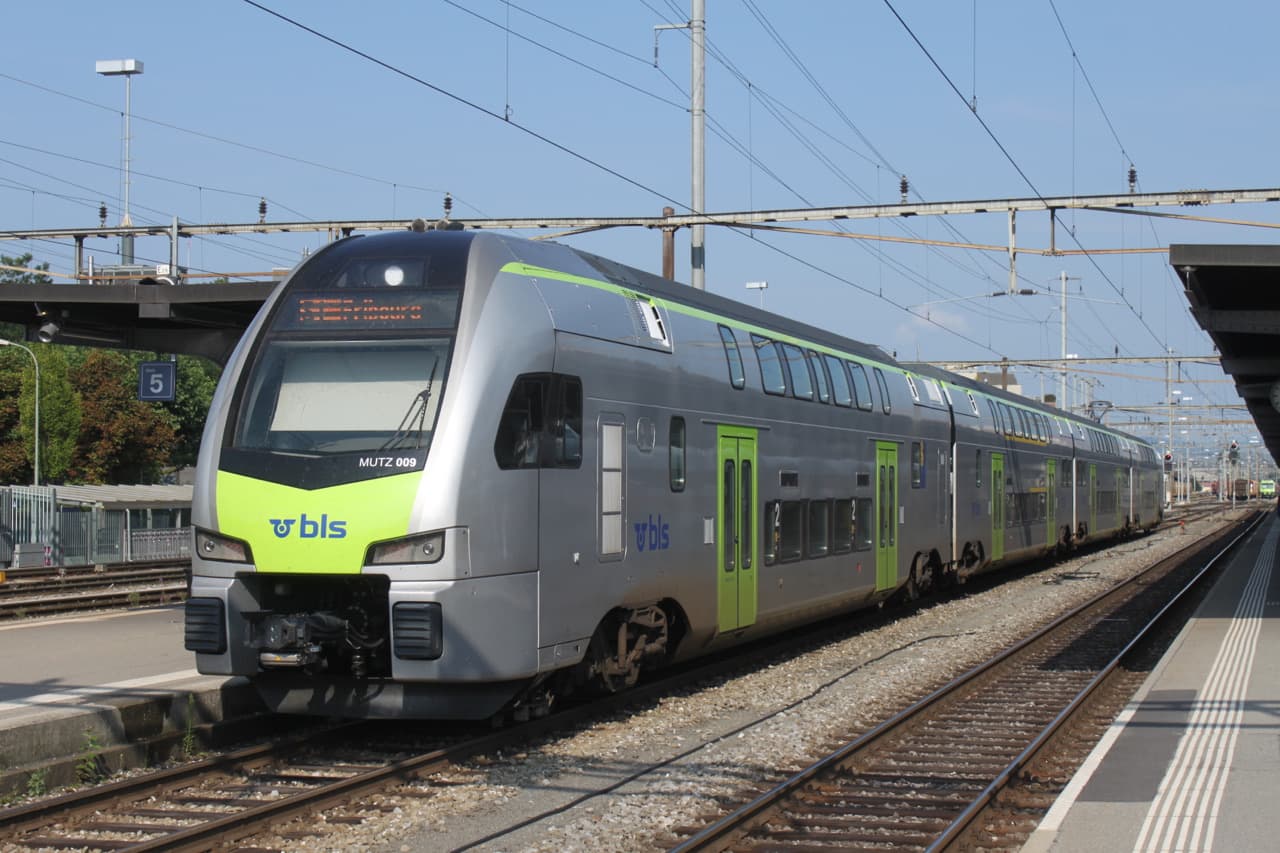
A KISS-shaped double-deck unit in BLS silver with lime-green front and doors. The rounded nose and low doors between the bogies match the SBB KISS; the colours are BLS's.
BLS runs 39 MUTZ: 31 four-car units and eight longer six-car units. They are the double-deck workhorses of the Bern S-Bahn, covering its busiest lines such as the S1 (Fribourg–Bern–Thun) and the S3/S31 (Biel–Bern–Belp), and since BLS took over some long-distance lines from SBB they also run the InterRegio services IR17 (Bern–Burgdorf–Olten) and IR65 (Bern–Biel). After a collision in December 2020 a fault in the brake system came to light; a software update fixed it across the fleet in 2021.
In the 2000s the Bern S-Bahn outgrew its single-deck trains, and BLS turned to double-deck stock to add seats without lengthening platforms. On 30 March 2010 it ordered 28 four-car KISS units from Stadler, built at Altenrhein. They entered service in December 2012 and arrived until 2014. Growing demand brought follow-up orders: three more four-car units in 2015 and, in 2018, three four-car and five six-car units, the latter for the InterRegio lines BLS had gained. The last were delivered by 2020.
A four-car MUTZ is about 102 m long and seats 61 in 1st and 274 in 2nd class; the six-car version stretches to about 152 m with 122 and 424 seats. Top speed is 160 km/h, and with around 4,000 kW the units accelerate briskly, which suits the tight station spacing of a commuter network. Boarding is at low-floor level on the lower deck, with stairs to the upper deck at both ends of each car. The trains are air-conditioned, have floor and wall heating and an accessible toilet. They run mainly in the Bern region — towards Thun, Fribourg, Biel, Belp and Burgdorf — and as far as Olten on the IR17.
RABe 515 — four- and six-car double-deck units
R marks a unit cleared for more than 110 km/h, A and B that it carries 1st and 2nd class, e that it is electric; together "RABe" is the standard label for a Swiss electric multiple unit with both classes. The series number 515 sits in the 5xx block reserved for standard-gauge multiple units, next to the other double-deckers (511 and 512 for SBB's KISS, 514 for the Zürich DTZ). MUTZ stands for "Moderner universeller Triebzug" (modern universal multiple unit) and doubles as the Bernese dialect word for bear, the heraldic animal of Bern. KISS is Stadler's type name: "Komfortabler innovativer spurtstarker S-Bahn-Zug".
FLIRT
FLIRT (Stadler)
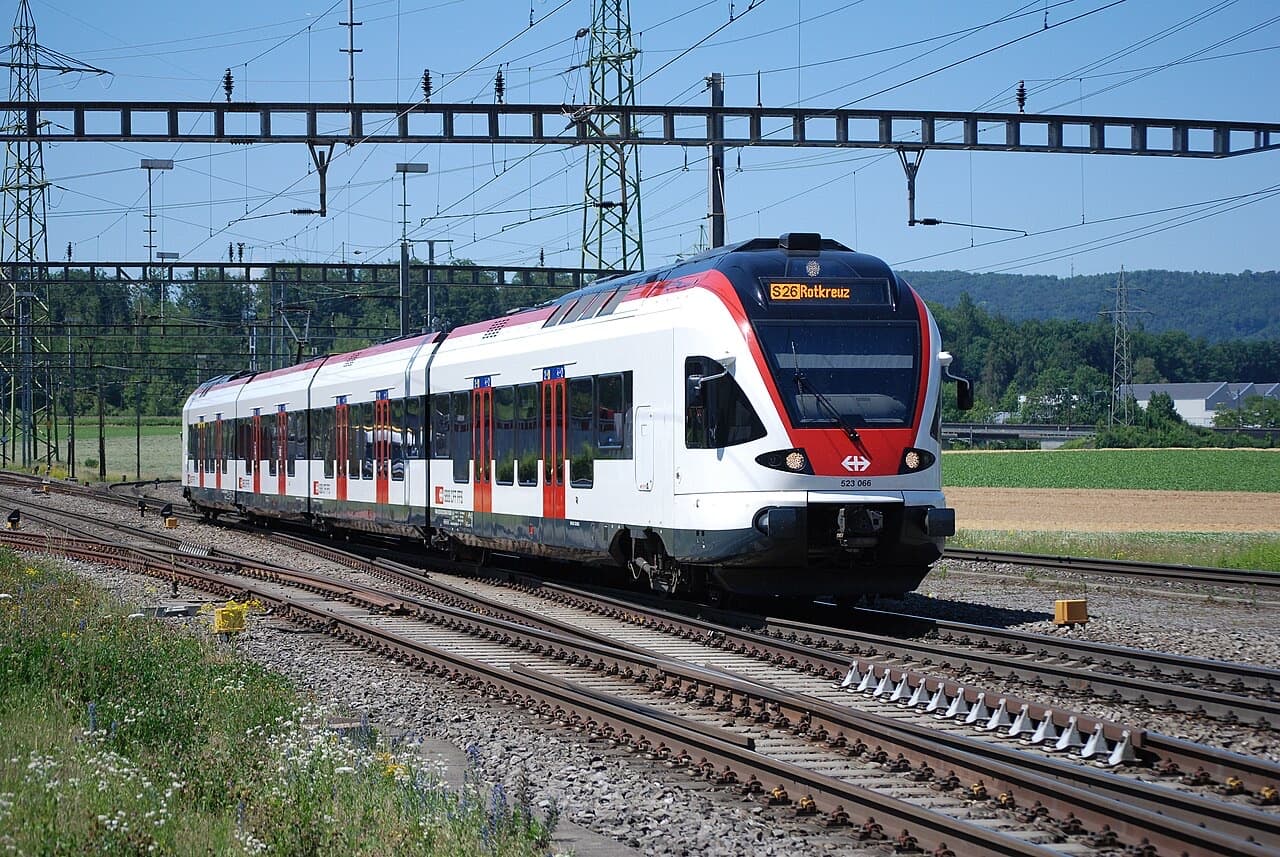
A single-deck unit with a short, rounded nose: on SBB units a white body, a red front and red doors. One bogie sits under each car joint, so the cars look closely linked. BLS's MIKA has the same build in silver and green and is longer, at six cars; SOB's FLIRTs carry SOB livery.
The FLIRT is the most common modern regional train in Switzerland. SBB alone runs well over a hundred, mostly four-car units: the 521 on the Basel S-Bahn and the German Wiesental line, the 522 on cross-border lines to France and on the Geneva Léman Express, the 523 on the Zug Stadtbahn, the Vaud RER and other regional lines, and the 524 for TILO in Ticino and Lombardy, partly as six-car units with ETCS Level 2. The Südostbahn, transN and TPF run their own fleets. Stadler has sold more than 3,000 FLIRTs worldwide.
SBB ordered the first 42 FLIRTs in September 2002, with options for 100 more, as a lighter, faster successor to older regional stock. Stadler presented the first unit on 4 June 2004 and delivered twelve to the Zug Stadtbahn from late 2004. Basel followed in 2005–2006 with 30 units, ten of them for SBB's German subsidiary on the Wiesental line, then the multi-voltage 522s for France and the 524s for TILO. Later batches went to the Vaud RER and other cantons, while private railways ordered their own. The design became Stadler's global best-seller and the base for successors such as BLS's MIKA and Thurbo's FLIRT Evo.
A four-car Swiss FLIRT is about 74 m long, seats around 180 (20 in 1st class in the standard SBB layout) and reaches 160 km/h. Roughly 90 % of the floor is low, with entrances matched to 55 cm platforms. The light aluminium body gives strong acceleration for closely spaced stops, and the step-free interior with wide gangways makes boarding and moving through the train easy. FLIRTs run in the Basel region, Zug and central Switzerland, the Jura and Arc lémanique, around Geneva and across the Ticino into Lombardy.
RABe 521, RABe 522, RABe 523, RABe 524 (TILO), RABe 526 (SOB), RABe 527
All Swiss FLIRTs are "RABe": R for a unit faster than 110 km/h, A and B for 1st and 2nd class, e for electric. The series numbers in the 52x block tell the variants apart by where they may run: 521 adds German equipment (Basel, Wiesental), 522 French equipment and the 25 kV supply (Jura, Basel–Mulhouse, Léman Express), 523 is the domestic version, 524 adds 3 kV DC for Italy (TILO, also listed there as ETR 524), and 527 covers small FLIRT fleets of regional railways such as transN. The cars share Jacobs bogies — one bogie under each joint — which lets passengers walk the whole train without steps. FLIRT stood for "Flinker leichter innovativer Regional-Triebzug"; Stadler now reads the I as Intercity. SOB's FLIRTs and its eight-car Traverso are numbered RABe 526.
Traverso
Traverso (Stadler FLIRT)
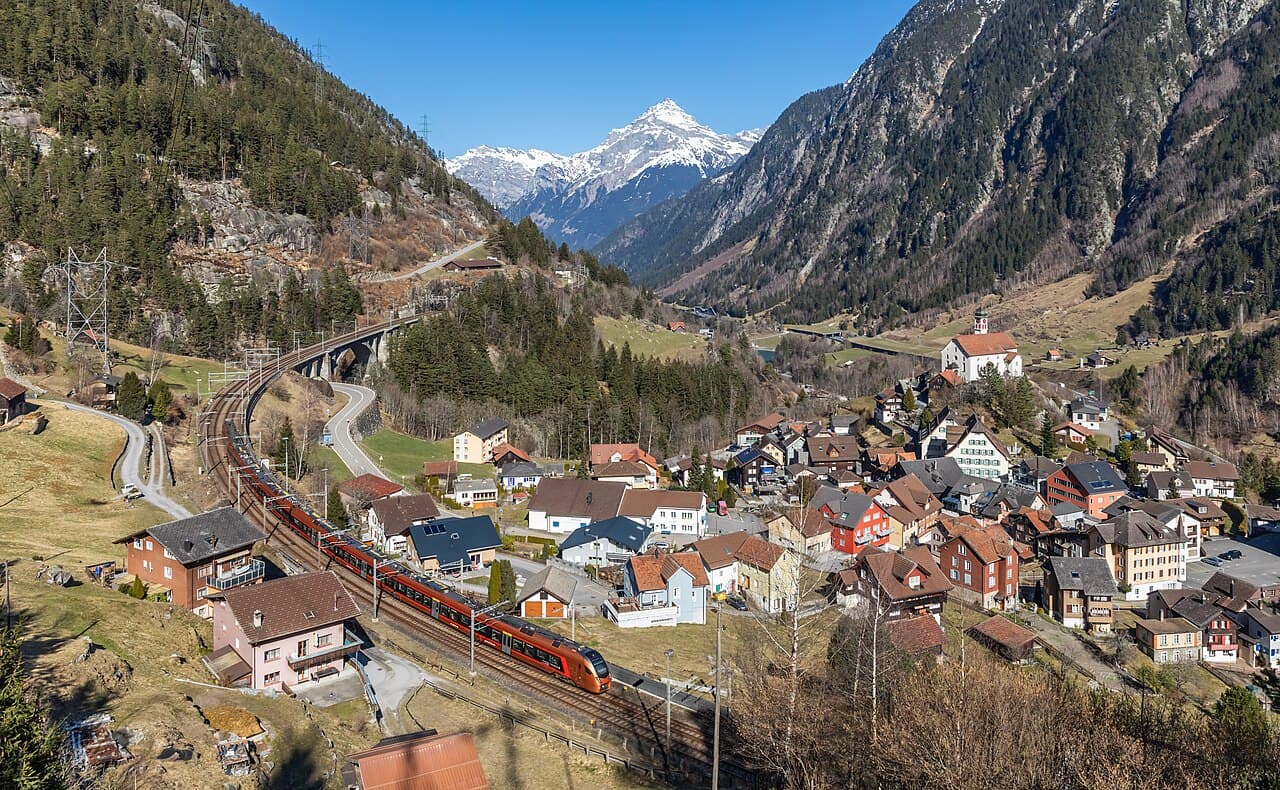
Copper all over, and at eight cars much longer than SOB's regional FLIRTs, which share its RABe 526 number.
SOB runs 30 Traversos on its long-distance lines: the Voralpen-Express St. Gallen–Rapperswil–Lucerne, the Treno Gottardo over the Gotthard mountain line from Basel and Zürich to Locarno, and, together with SBB, the IR 35 "Aare Linth" Bern–Zürich–Chur.
For the Voralpen-Express, SOB ordered six eight-car units from Stadler in June 2016. For the InterRegio over the Gotthard mountain line, which SOB took over from SBB, eleven more followed in December 2017, then seven in December 2018 for the Aare Linth line, about 480 million francs in total. The first Traversos entered service on the Voralpen-Express in December 2019, on the Treno Gottardo a year later and between Chur and Bern in December 2021. A fourth batch arrived in 2024.
A Traverso is 150 m long and reaches 160 km/h. It seats 359 — 68 in 1st class and 291 in 2nd — plus 21 folding seats, on a low floor with step-free entrances. Vending machines replace a dining car. The copper livery stands, according to SOB, for the historical development of human society.
RABe 526 — eight-car units
RABe is the standard label for a Swiss electric multiple unit: R for a unit faster than 110 km/h, A and B for 1st and 2nd class, e for electric. SOB files the Traverso under the same series number 526 as its regional FLIRTs, which it is built on.
MIKA
MIKA (Stadler FLIRT)
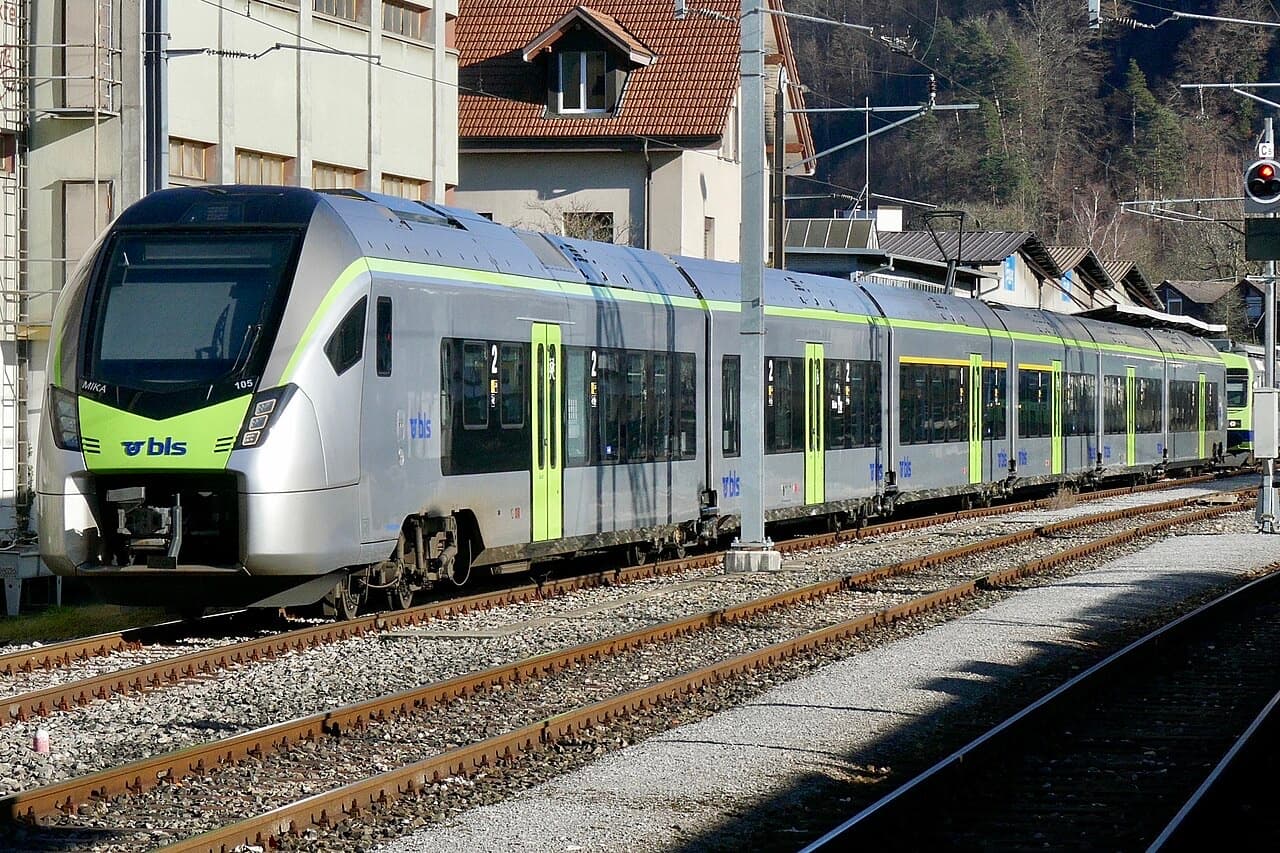
Silver with lime-green accents and a sloping front with a wide, raked windscreen. At six cars on shared bogies it is far longer than the NINA and the Lötschberger, the other silver-and-green BLS trains, whose fronts are more upright.
MIKA is BLS's standard single-deck train. All 58 units of the original order are in service, on RegioExpress lines such as Bern–Spiez–Brig–Domodossola, Bern–Langnau–Lucerne and Spiez–Zweisimmen, on the IR66 Bern–Neuchâtel–La Chaux-de-Fonds and on Bern S-Bahn lines including the S2, S4, S6 and S7. They replaced locomotive-hauled EW III coaches and older RBDe 565/566 units, and from December 2024 also took over the S6 and S7 from the NINA. Seven further units, ordered in 2024, serve the InterRegio between Biel and Basel that BLS runs from December 2025; two more were ordered in 2025.
BLS needed to replace a mix of ageing coaches and early multiple units on its regional and RegioExpress network, and chose a single type for both roles. In 2017 it ordered 58 six-car FLIRTs from Stadler for about 650 million francs, with signal-permeable windows for mobile reception. The first units entered passenger service on 10 May 2021 on the IR66 Bern–Neuchâtel; all 30 RegioExpress units were delivered by May 2023 and the S-Bahn units followed. A dozen units now carry the names and coats of arms of communes along the BLS network, two of them in Italy.
A MIKA is 104.9 m long and reaches 160 km/h with 3,500 kW. The RegioExpress version seats 275 — 46 in 1st class, 198 in 2nd and 31 on folding seats — while the S-Bahn version has 35 1st-class, 188 2nd-class and 12 folding seats. Both versions are identical underneath and can run coupled. The interior has large panoramic windows, sockets at almost every seat, multi-purpose zones for bikes, prams and luggage, and on RE units a bistro zone with vending machines. MIKA runs across the BLS network: the Bern S-Bahn, the Emmental and Entlebuch towards Lucerne, the Bernese Oberland, the Simplon line into Italy, and the Jura foot towards Neuchâtel and Basel.
RABe 528 — six-car units, RegioExpress 101–130, S-Bahn 201–228
RABe is the standard label for a Swiss electric multiple unit: R for a unit faster than 110 km/h, A and B for 1st and 2nd class, e for electric. The series number 528 continues the 52x block used for single-deck FLIRT-family units. The running numbers show the version: 528 101–130 have the RegioExpress interior with more 1st-class seats and a bistro zone, 528 201–228 the S-Bahn layout with more standing room. MIKA stands for "moderner innovativer kompakter Allroundzug" (modern, innovative, compact all-rounder); one unit, 528 113, carries the name AKIM, MIKA spelled backwards. The six cars sit on Jacobs bogies, one under each joint.
GTW
GTW (Stadler Gelenktriebwagen)
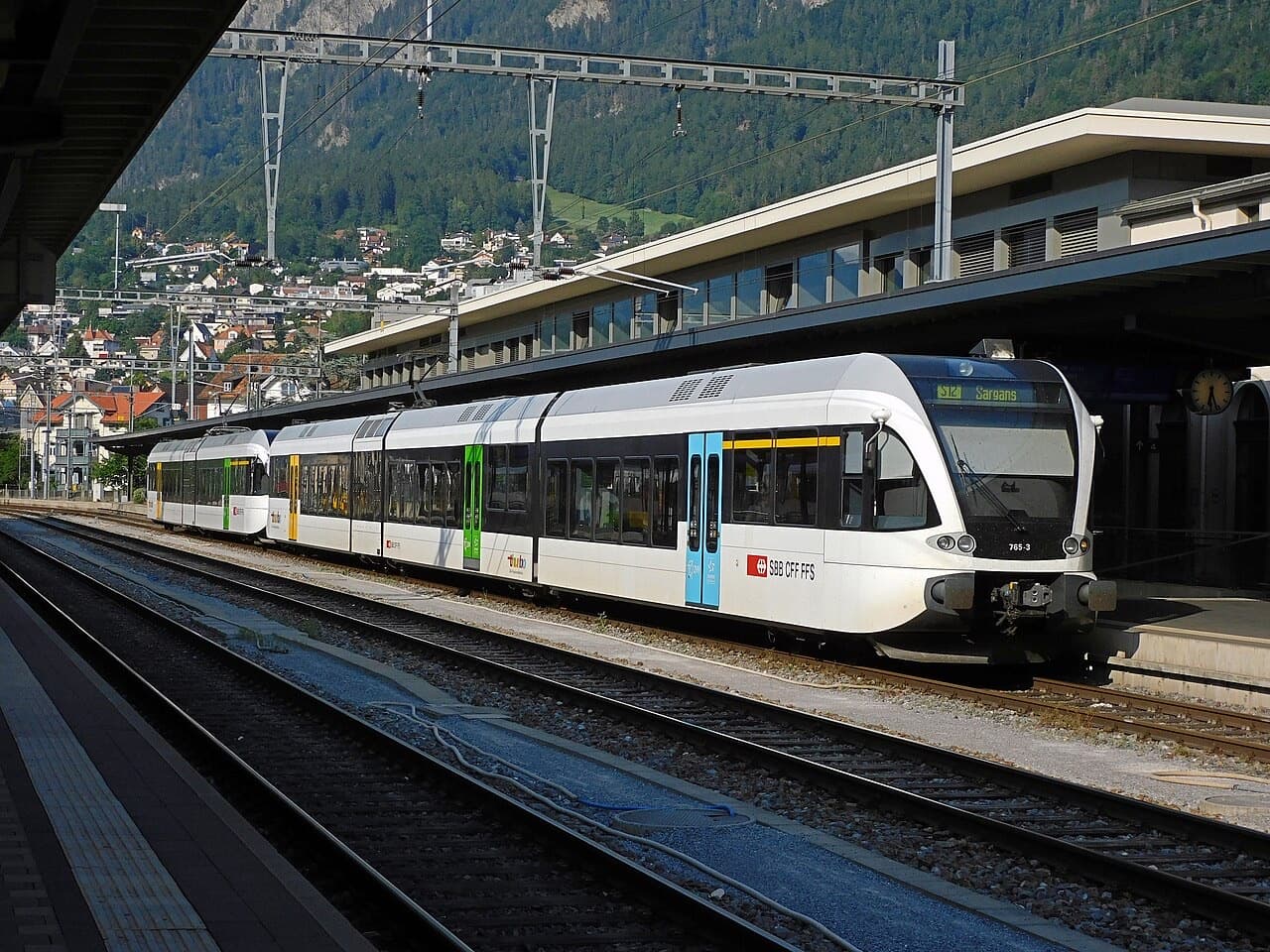
White, with a short, windowless power module in the middle of the train, between the passenger cars. The front is rounded, with a large windscreen. Thurbo units have doors in bright single colours. No other train in the guide has this middle module, though SBB's Seetal unit shares it.
Two Swiss fleets remain matched here. SBB runs the 520 on the Seetal line Lenzburg–Lucerne (S9), with a couple of units on the S36 Bülach–Waldshut. Thurbo runs over a hundred GTWs across eastern Switzerland — 41 GTW 2/6 and about 67 GTW 2/8 — around Winterthur, St. Gallen, Thurgau, Schaffhausen and Lake Constance. Both fleets are being replaced: Thurbo's first FLIRT Evo units entered regular service on the S26 Winterthur–Rüti on 6 July 2026, and the switch will run until the mid-2030s. For the Seetal, SBB ordered eleven new narrow-bodied units from Stadler in 2024, planned from around 2029.
Stadler developed the GTW in the mid-1990s as a light, low-floor railcar for branch lines; between 1996 and 2017 it sold more than 600 units. SBB ordered 17 units with a body about 2.65 m wide for the Seetal line, where trains run close beside the road; they were built in 2002–2003. Thurbo, founded in 2001 as SBB's regional operator for eastern Switzerland, took GTWs from 2003, mostly by 2007 and with later batches until 2013, replacing older stock. SBB refurbished its Seetal units in 2018–2021, adding a raised entrance at 55 cm with an internal ramp. Stricter crash rules ended new GTW production; the WINK succeeded it.
A Thurbo GTW 2/6 seats 106 (16 in 1st class), the 2/8 162; both reach 140 km/h. SBB's Seetal unit is 53.4 m long, seats 124 (12 in 1st class) and is limited to 115 km/h. The low floor makes boarding easy at low rural platforms, but the power module splits the interior: passengers walk through a narrow corridor past the machinery to reach the other end. Capacity is tight at peak hours, one reason for the switch to the larger FLIRT Evo. GTWs run in eastern Switzerland from Zürich's outer suburbs to the Rhine and Lake Constance, and in the Seetal between Aargau and Lucerne.
RABe 520 (SBB Seetal), RABe 526 7xx/8xx (Thurbo, GTW 2/6 and 2/8)
GTW means "Gelenktriebwagen", articulated railcar. Its fractions follow the Swiss axle scheme — driven axles over total axles: a GTW 2/6 has two powered axles out of six, a GTW 2/8 two out of eight. The two powered axles sit in a short power module in the middle that carries the motors and electrics; the passenger cars rest on it, so their floors stay low. RABe marks an electric multiple unit faster than 110 km/h (R) with 1st and 2nd class (A, B) and electric drive (e). SBB numbers its narrow Seetal units 520; Thurbo's units carry 526 with running numbers from 701, while SOB uses the 526 range for its FLIRTs.
NINA
NINA (Niederflur-Nahverkehrszug)
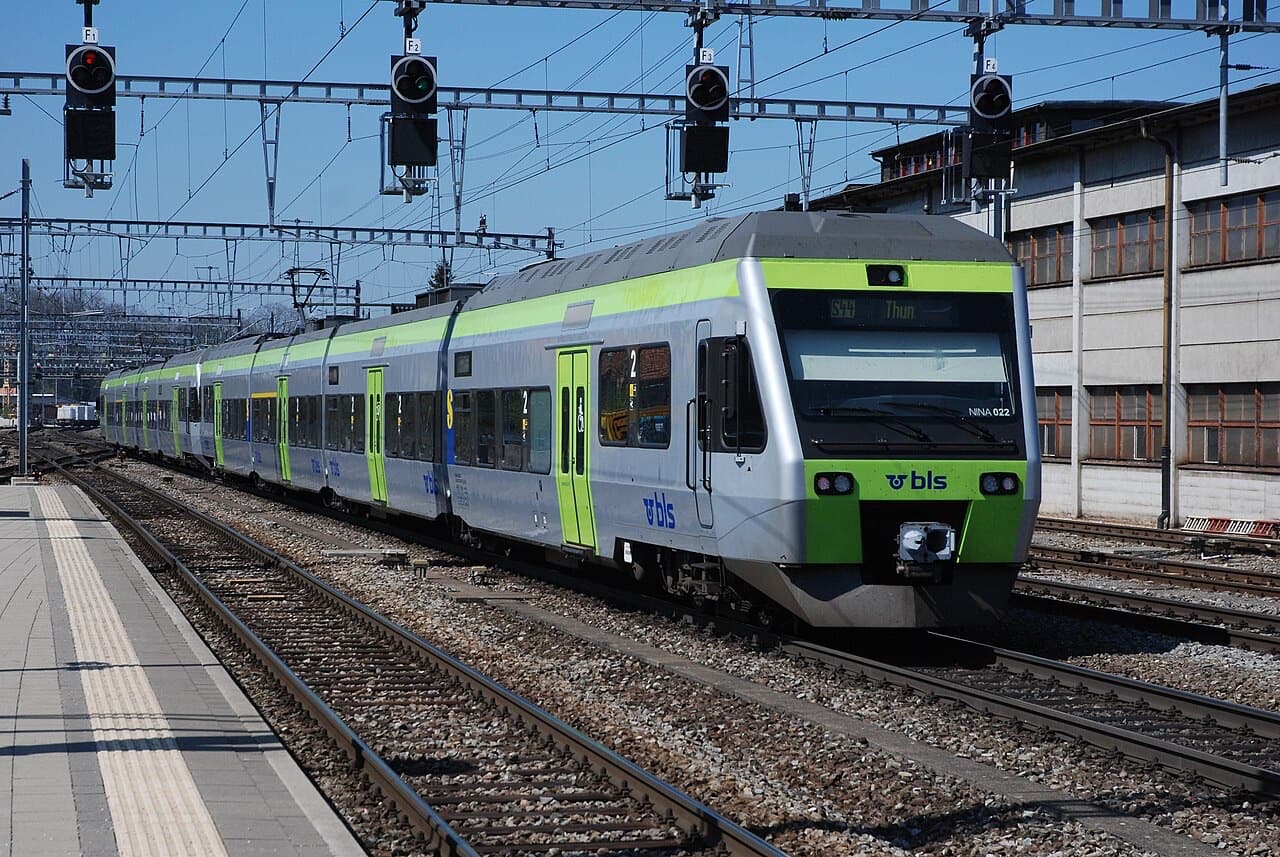
Silver and lime green like other BLS trains, with a boxy front: a near-vertical windscreen above a lime-green panel. Much shorter than a MIKA. The Lötschberger looks similar, but its front is rounder.
BLS runs about three dozen NINAs — 23 three-car and 13 four-car units — on Bern S-Bahn lines and around Lucerne. Since December 2024 the MIKA has taken over the S6 and S7, so the NINA is concentrated on shorter and lighter lines. A few units belong to other operators in western Switzerland, such as Regionalps in Valais. The fleet nears the end of its life: under the "Neue Flotte 2032" project BLS plans to replace the NINA and the Lötschberger with 36 to 40 new single-deck trains, with the tender planned for November 2026 and first deliveries from 2032.
In the 1990s BLS and the Bern S-Bahn wanted level boarding on low platforms. Vevey Technologies developed the NINA in the mid-1990s together with Bombardier-Talbot in Aachen, borrowing low-floor principles from Bombardier's Talent; the electrical equipment came from Holec (later Alstom). The units were delivered between 1998 and 2005 and became, for many years, the typical Bern S-Bahn train before the double-deck MUTZ arrived. Between 2015 and 2019 BLS refurbished the fleet, moving 1st class into the low-floor sections and bringing interior and livery in line with its newer trains.
The three-car NINA is 47.7 m long with 148 seats, the four-car version 61.9 m with 191 seats. Top speed is 140 km/h, power 1,000 kW — modest next to the MUTZ or MIKA, which shows on faster lines. Most of the interior is low-floor, with entrances close to platform height, and the trains are air-conditioned. Passengers appreciate the easy boarding; the lower top speed and the smaller capacity are the reasons BLS has moved its busiest lines to newer stock. NINAs run on Bern S-Bahn lines such as the S5 and S44 and on the S77 around Lucerne.
RABe 525 — three- and four-car units
NINA stands for "Niederflur-Nahverkehrszug", low-floor local train. RABe is the standard Swiss label for an electric multiple unit faster than 110 km/h (R) with 1st and 2nd class (A, B) and electric drive (e). The series number 525 places it in the 5xx block for standard-gauge multiple units. Running numbers distinguish the units, which come in three-car and four-car lengths; they can be coupled in any mix, up to four units together.
Lötschberger
Lötschberger
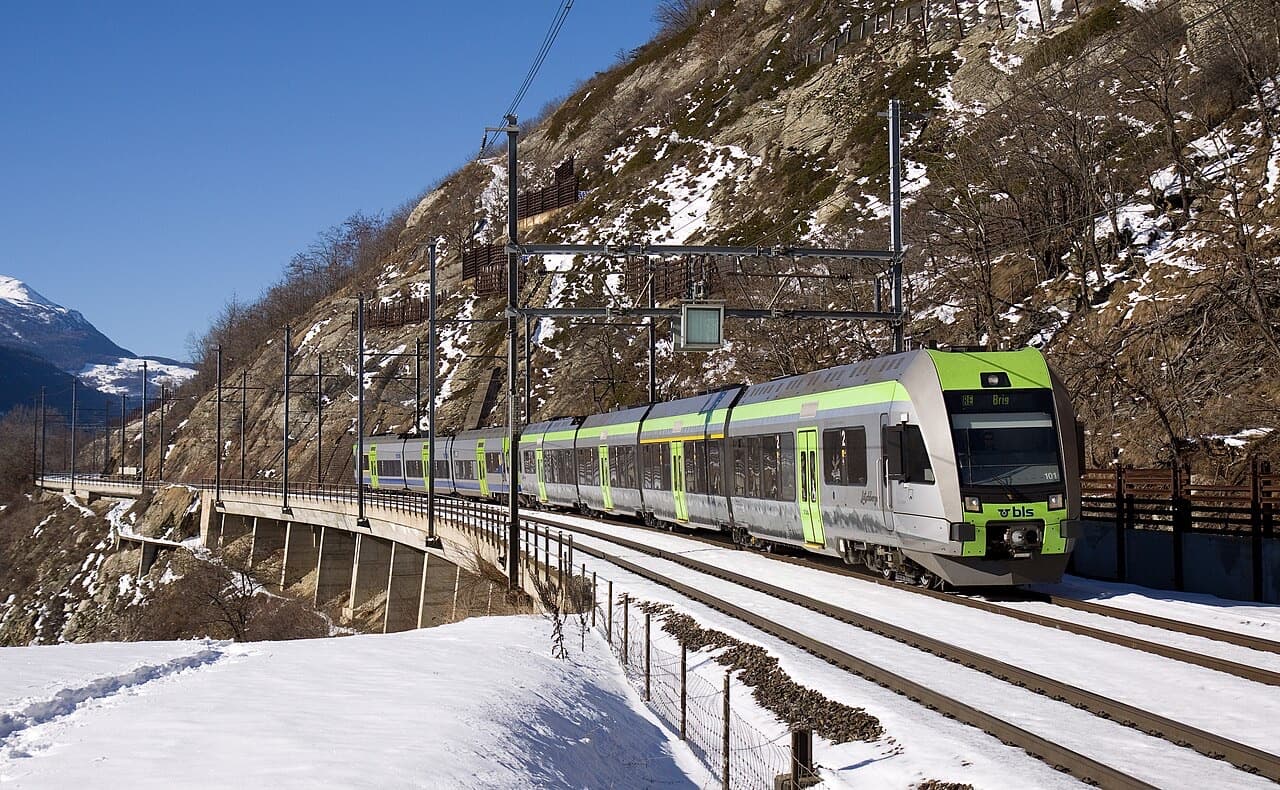
Silver and lime green, with a rounded front and a slightly raked windscreen. Short like the NINA, which has a flatter, more upright front.
BLS runs all 25 Lötschberger, numbered 535 101 to 125. Built for the Lötschberg mountain line, they now work across the BLS network: Bern S-Bahn services, regional trains in the Bernese Oberland and, until the MIKA (RABe 528) took over there, routes towards Lucerne. Since mid-2024 the fleet goes through a mid-life refit at the BLS workshop in Bönigen, at most two trains at a time, finishing in 2027. It brings LED lighting, CO2-controlled ventilation, twice as many sockets and the MIKA-style livery; the "Lötschberger" lettering disappears though the name stays. BLS plans to run them until about 2037 and then replace them together with the NINA.
In the mid-2000s BLS needed modern, faster trains for its RegioExpress between Bern and Brig over the Lötschberg mountain line, which lost its through long-distance traffic when the Lötschberg base tunnel opened in 2007. In 2006 it ordered 13 units, an evolution of its NINA, from Bombardier; eight more were added in 2008 and a further four in 2011, for 25 in total. The first units were assembled in Vevey by Vevey Technologies, the later ones by Bombardier, with deliveries from 2008 to 2012. They entered passenger service from 2009 and took the informal name of the line they were bought for.
A Lötschberger is a four-car articulated train 62.7 m long, with four 250 kW asynchronous motors (1,000 kW in total) and a top speed of 160 km/h. It seats 28 in 1st and 143 in 2nd class, and about 85 % of the floor is low, giving step-free boarding at most regional platforms. Automatic Scharfenberg couplers let crews join or split units quickly, and it can run in multiple with the NINA, so mixed pairs are common. After the RegioExpress on the Lötschberg mountain line moved to other stock at the end of 2022, the trains spread to the wider BLS network, including the Emmental and the Bernese Oberland.
RABe 535 (units 535 101–125)
Swiss multiple units are named after their powered vehicle. R marks rolling stock cleared for more than 110 km/h, A and B mean the train carries 1st- and 2nd-class seats, e that it is electric, and Be on its own would be a 2nd-class electric railcar. Series numbers in the 500s are standard-gauge multiple units; 535 sits right after the BLS's own NINA (RABe 525), from which it was developed. The axle layout Bo'2'2'2'Bo' shows a powered two-axle bogie (Bo') under each end and three unpowered Jacobs bogies shared between the four articulated cars.
Spatz
Spatz (Stadler SPATZ)
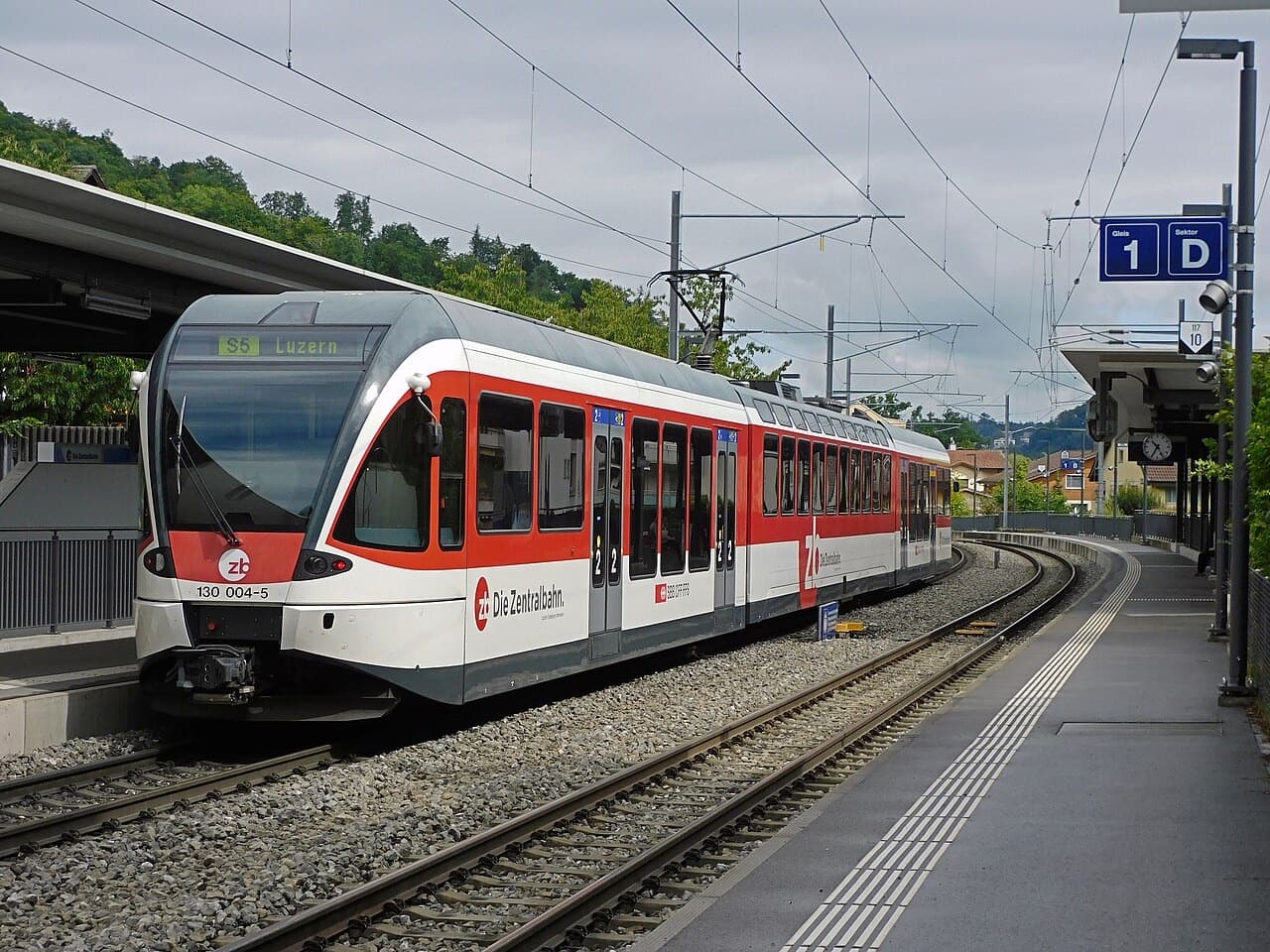
Red and white zb livery with a white, rounded nose. Adler and Fink, zb's newer trains, have a dark front with three round headlights and a large "zb" on the first car.
The Zentralbahn (zb) owns ten Spatz units. They work the adhesion-only parts of its metre-gauge network: S-Bahn Luzern services from Lucerne to Giswil and to Wolfenschiessen, and regional trains between Meiringen and Interlaken Ost along Lake Brienz. Between 2020 and 2023 the fleet received an overhaul covering doors, floors and toilets. The type also exists outside the zb: SNCF runs six as Z 850 on the Saint-Gervais–Vallorcine line, and the Martigny-based TMR has two rack-equipped Beh 4/8.
The Spatz was ordered by SBB for its Brünig line, its only metre-gauge railway, shortly before that line merged with the Luzern–Stans–Engelberg railway to form the Zentralbahn in 2005. SBB needed the first two units urgently for the December 2004 timetable, which brought a tighter schedule between Meiringen and Interlaken. Stadler built all ten in 2004 and 2005, adapting a design it had developed for the Täsch–Zermatt shuttle. The name is the German word for sparrow and is read as an acronym of "Schmalspur-Panorama-Triebzug", narrow-gauge panoramic multiple unit; the Zentralbahn later kept the bird theme with the Adler and the Fink.
A zb Spatz is 51.9 m long, rated at 1,150 kW and limited to 100 km/h. It seats 19 in 1st and 115 in 2nd class, plus 14 folding seats. Its layout is unusual: a high-floor centre car with large panoramic windows and no doors, flanked by low-floor end modules that hold all the entrances, so boarding is step-free while the middle offers the view. Passengers changing at the Lake Brienz shore or riding into Lucerne from Obwalden and Nidwalden meet it most often. Because it lacks a rack drive, it never climbs to the Brünig Pass or to Engelberg.
ABe 130
ABe reads A + B for 1st and 2nd class and e for electric drive; 130 is the series. Unlike standard-gauge stock there is no leading R: on Swiss metre-gauge railways the speed prefix is not used, even for trains that are fairly fast. Also missing is an h, which would mark a rack drive — the Zentralbahn Spatz runs on adhesion only, so it stays off the steep Brünig and Engelberg rack sections. Older Swiss practice added axle fractions (e.g. Beh 4/8 for 4 driven of 8 axles, still used for related units elsewhere); the Zentralbahn uses series numbers instead. The axle layout 2'Bo'Bo'2' is a powered centre car on two motor bogies (Bo') with an unpowered bogie (2') under each end module.
Adler
ADLER
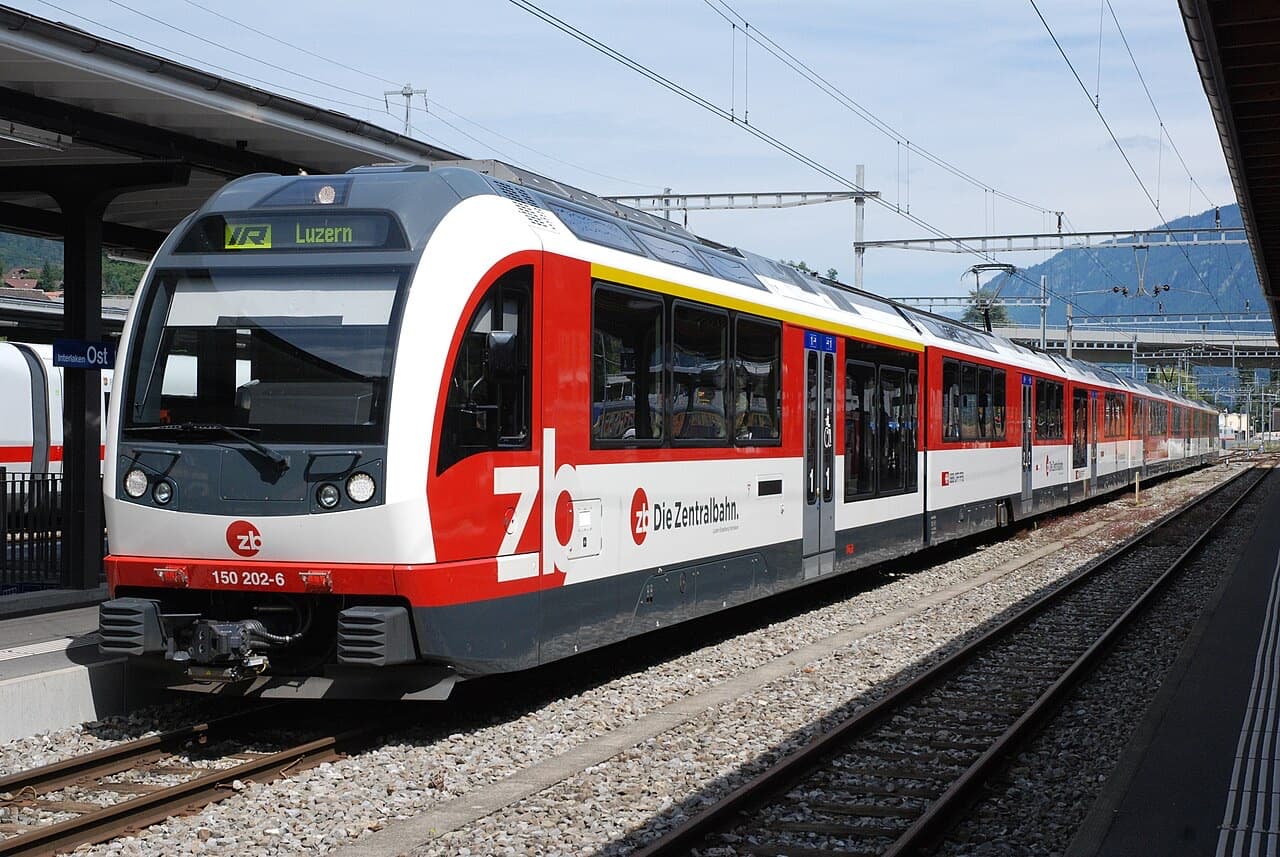
Red and white zb livery with a dark grey front, three round headlights in a triangle and a large "zb" on the first car. It shares that front with the Fink but is much longer.
The Zentralbahn has four Adler sets. They form the core of the hourly Luzern–Interlaken Express (IR 70) over the Brünig Pass between Lucerne and Interlaken Ost, often strengthened by a three-car Fink at busy times. The first set, in service since November 2012, passed two million kilometres in April 2024. Growing leisure and international tourist traffic on the Brünig has led to a follow-up order: Stadler is to supply seven further Adler for longer-distance zb services from the end of 2027.
The Zentralbahn ordered the Adler from Stadler Rail in 2009, together with the shorter Fink, to replace locomotive-hauled trains on the Brünig line. They are the longest metre-gauge trains Stadler had built at that point. The four sets were built in 2012 and 2013, entered service from late 2012 and had taken over the Interregio between Lucerne and Interlaken by 2013. In 2021 a gear fracture led to a temporary speed cut from 30 to 20 km/h when leaving rack sections, until a software change was made.
An Adler is 126 m long and weighs about 200 t. It reaches 120 km/h on adhesion track, climbs at 40 km/h on the rack and descends at around 30 km/h. It handles gradients of 35 ‰ by adhesion and 120 ‰ on the Riggenbach rack sections over the Brünig. Rated output is 2,800 kW in adhesion and 3,200 kW on the rack. It seats 317, 74 of them in 1st class, plus 10 folding seats; four of the seven doors on each side are at low-floor level. The rack drive can be adjusted in height via an eccentric mount, so wheels may wear 35 mm instead of the usual 12 mm before the pinion sits too low. The route passes Lake Lucerne, Lake Sarnen, Lake Lungern, the Brünig Pass and Lake Brienz.
ABeh 150 (units 150 001–004)
A and B mean 1st and 2nd class, e electric drive, h a rack drive (Zahnrad) for the cogwheel sections, and 150 the series. As on all Swiss metre-gauge railways there is no R speed prefix, although the train reaches 120 km/h. "ADLER" (German for eagle) is an acronym: Zentralbahn and press releases expand it as "alpiner, dynamischer, leiser, eleganter Reisezug" — an alpine, dynamic, quiet, elegant travelling train. Each set is seven cars long: two three-car powered halves that could run independently, joined by an unpowered snack car in the middle.
Fink
FINK
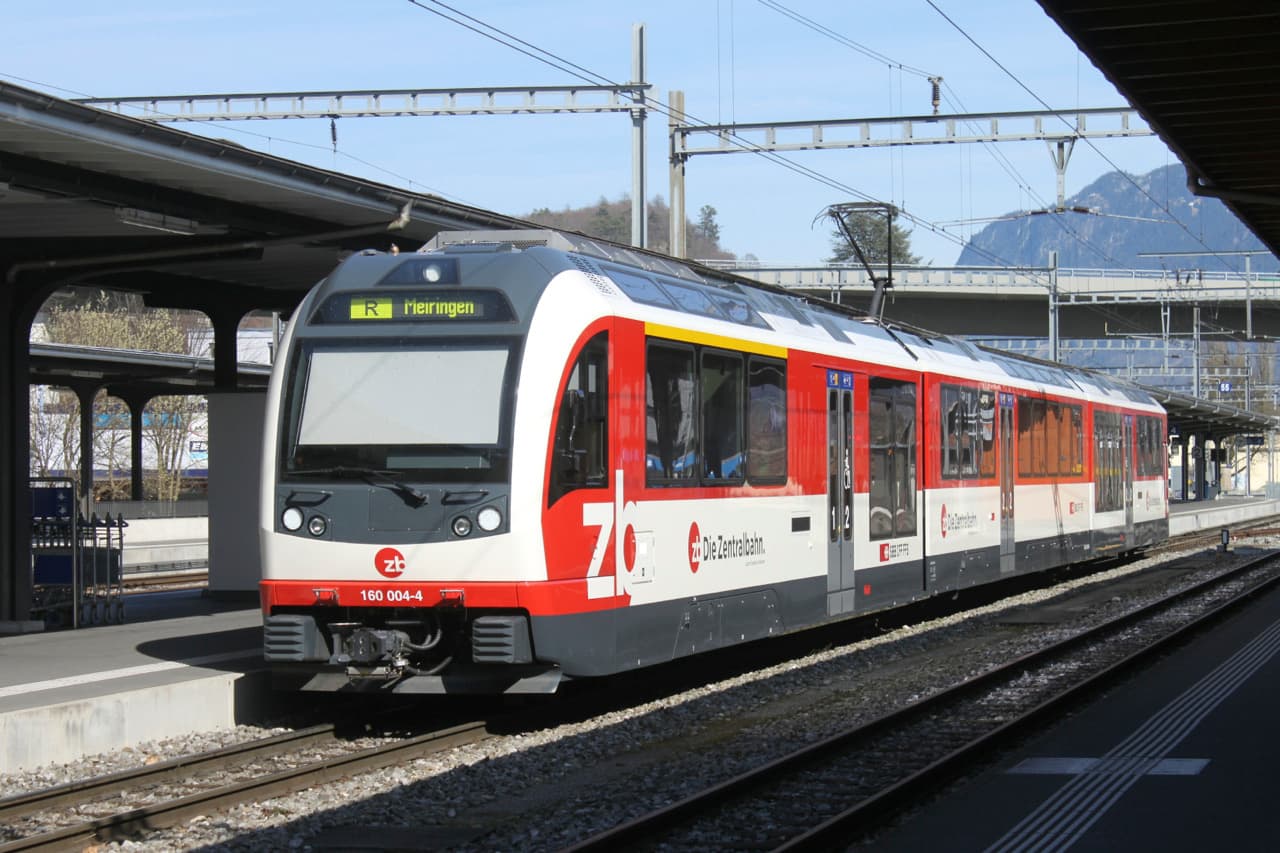
Same front as the Adler: dark grey, three round headlights, a large "zb" on the first car. It is short, at three cars, while an Adler stretches several times as long.
The Zentralbahn runs eleven Fink of the first two series on S-Bahn Luzern services and as reinforcement for the Adler on the Luzern–Interlaken Express, coupled in multiple. A third generation is arriving: the first of ten ABeh 162, the largest vehicle order in the zb's history, reached Meiringen from Stadler's Bussnang plant in August 2026. They are due to enter service with the timetable change on 13 December 2026, when a half-hourly service starts between Lucerne and Engelberg, with the rest following in the weeks after.
The Zentralbahn ordered six Fink together with the Adler from Stadler Rail in 2009, as part of one fleet renewal that replaced locomotive-hauled trains on its network. The ABeh 160 entered service in 2012 and, with the Adler, had displaced the older trains by 2013. Five more followed in 2016 as ABeh 161; their wheels were enlarged and fitted with tyres because the first series wore them out faster than expected. In 2021 the Zentralbahn signed for further rack-equipped Fink to expand capacity, chiefly on the Lucerne–Engelberg line; that order grew into the ten ABeh 162 now being delivered.
A Fink is 54 m long, reaches 120 km/h in adhesion and climbs at 40 km/h on the rack. It is rated at 1,400 kW in adhesion and 1,600 kW on the rack, using six traction motors and Riggenbach rack drives that work independently of the adhesion drive, so the wheels cannot slip on rack sections. The first two series seat 147, including 18 in 1st class, plus 8 folding seats; the ABeh 162 has 17 1st- and 111 2nd-class seats. Low-floor entrances give step-free boarding. Fink sets run throughout the zb network around Lucerne, over the Brünig and, with the new series, to Engelberg.
ABeh 160, ABeh 161, ABeh 162
As with the Adler, A and B stand for 1st and 2nd class, e for electric drive and h for the rack drive, with no R speed prefix because Swiss metre-gauge railways do not use it. The series number tracks the build: 160 001–006 are the 2012 originals, 161 011–015 the 2016 batch with modified wheels, and 162 021–030 the generation delivered from 2026. "FINK" (German for finch) stands for "Flinke innovative Niederflurkomposition", an agile, innovative low-floor train. Each set is three articulated cars with a cab at both ends, roughly equivalent to one half of an Adler.
Alvra
Alvra (Albula-Gliederzug, Stadler)
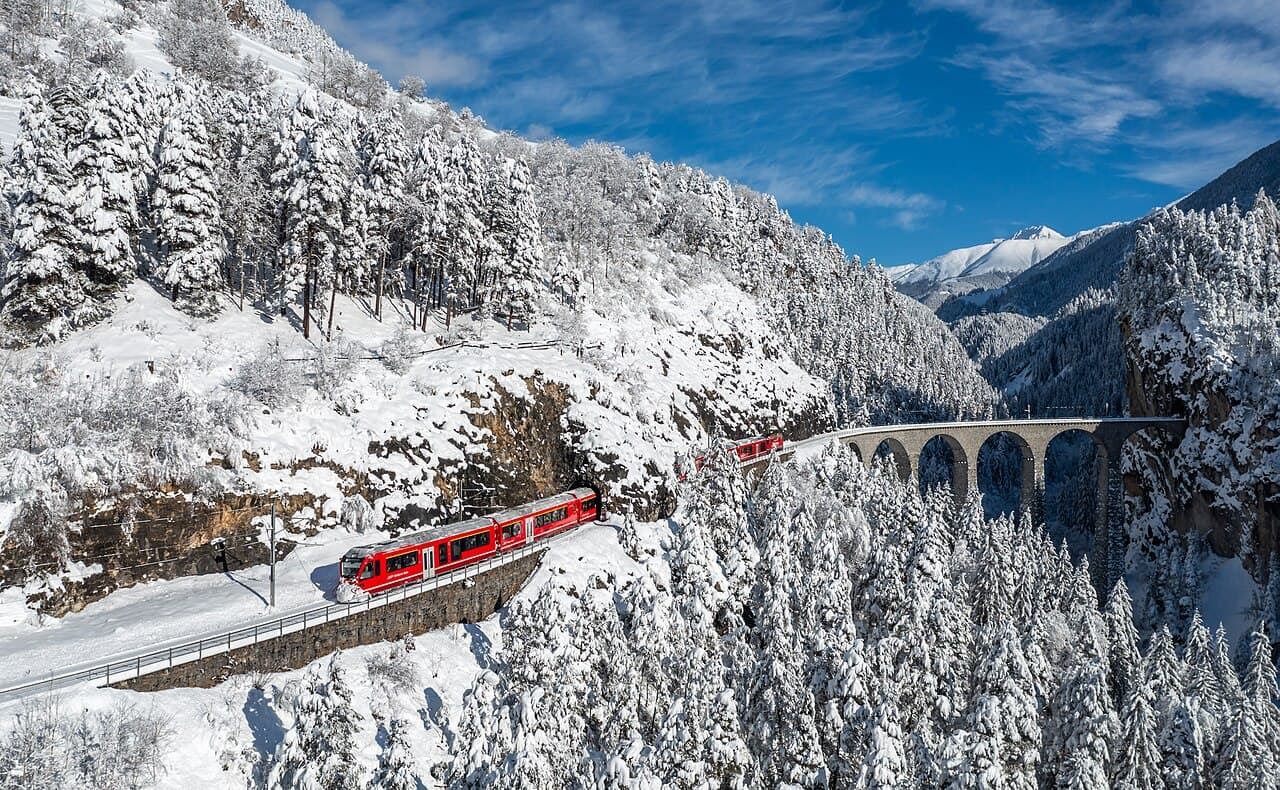
Always coupled to a locomotive, and only on the Albula line; the end car's photo section has tall windows reaching almost to the floor.
All six sets run the InterRegio Chur–St. Moritz over the Albula line, a UNESCO World Heritage route, hauled or pushed by a Ge 4/4 II or III locomotive.
RhB tendered seven sets for the Albula line in 2010 and awarded the contract to Stadler in December that year. It later cut the order to six sets and added control cars, so trains could reverse at the termini without moving the locomotive; the change caused significant delays. Stadler built the sets in Altenrhein from 2014, the first arrived in Landquart in December 2015, and the last control cars followed in September 2017. Two sets entered regular passenger service in November 2018.
A set with its control car is 112 m long and seats 63 in 1st class and 217 in 2nd. The air-conditioned aluminium coaches ride on air suspension; low-floor sections with deployable steps make boarding level. The Bi end car has a photo section whose windows open electrically, for pictures of the Landwasser viaduct, and the B 577 a family and leisure area with room for bikes and sports equipment.
Sets 5701–5706: A 570, AB 572, B 573, B 574, B 577, Bi 576, control car At 578
Alvra is Romansh for the Albula. The set is not a multiple unit but six short-coupled coaches, so each car keeps its own coach code: A for 1st class, B for 2nd, AB for both, and the t in At 578 for a control car (Steuerwagen).
Glacier Express
Glacier Express
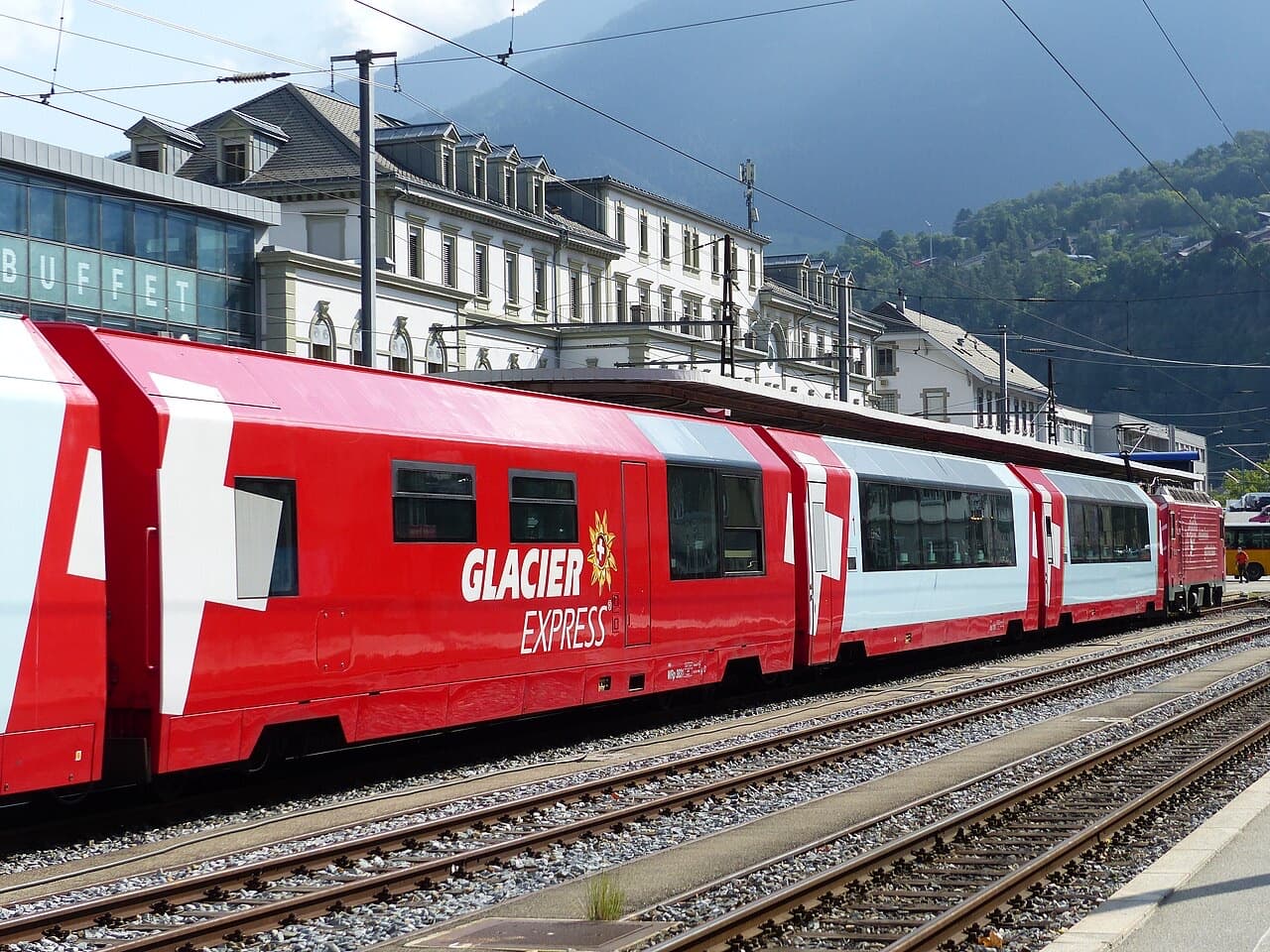
Red coaches with large white graphics and "Glacier Express" lettering, panorama windows curving up into the roof, pulled by a red locomotive. The Bernina Express also runs red panorama coaches, but without the white graphics.
The Glacier Express is a panorama train between Zermatt and St. Moritz, operated by Glacier Express AG, a company owned jointly by the Matterhorn Gotthard Bahn (MGB) and the Rhaetian Railway (RhB) since 2017. MGB runs the western half from Zermatt via Brig and Andermatt to Disentis, RhB the eastern half via Chur and the Albula line; locomotives change at Disentis. It runs most of the year, with a break in late autumn. Reservation is compulsory, meals are served at the seat, and since 2019 an Excellence Class coach with 20 seats, bar and supplement sits on top of 1st and 2nd class.
The first Glacier Express ran on 25 June 1930 and took almost 11 hours, steam-hauled on the Furka section. Because the Furka pass line was snowed in during winter, the train was seasonal until the 15.4 km Furka Base Tunnel opened in 1982; it has run year-round since. A first generation of 1st-class panorama coaches arrived between 1986 and 1993. The present fleet, built by Stadler in 2005–2006 and 2009 for both railways, introduced the red and blue livery and panorama coaches in both classes. In 2019 two of them were converted into Excellence Class coaches.
The route is 291 km long and takes about eight hours, hence the nickname "slowest express train in the world". It crosses 291 bridges, passes through 91 tunnels and reaches its highest point at the Oberalp Pass at 2033 m; 23.9 km have a rack rail, all on the MGB part. The whole line is metre gauge, electrified at 11 kV 16.7 Hz. Highlights include the Rhine Gorge, the Landwasser Viaduct on the UNESCO-listed Albula line, and the Oberalp climb out of Andermatt.
RhB/MGB panorama coaches Api, Ap, Bp, WRp, Aps (Excellence Class); Ge 4/4 III and HGe 4/4 II locomotives
On these metre-gauge coaches A is 1st class, B 2nd, and the lowercase p marks a panorama coach; Api is the 1st-class version with an accessible toilet, WRp a panorama car with a kitchen and bar, and Aps the Excellence Class coach (s for salon). Locomotive codes describe the machine: G is a narrow-gauge locomotive, e electric, H adds a rack drive, and 4/4 means four of four axles are driven. So the RhB Ge 4/4 III is an adhesion-only electric locomotive (third series), while MGB's HGe 4/4 II can climb rack sections. In SBB's data the train shows as line "PE GEX".
Bernina Express
Bernina Express
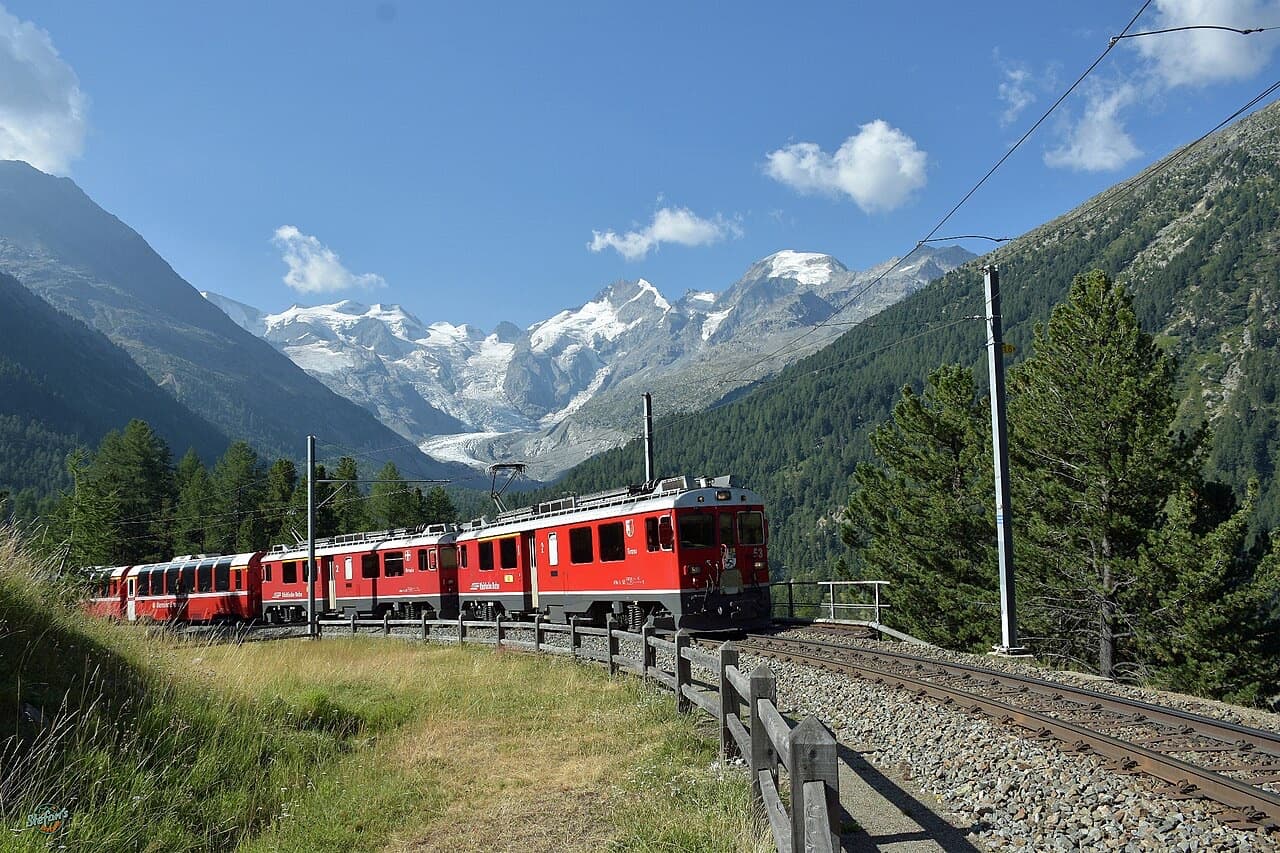
Panorama coaches in plain RhB red, the windows reaching up into the roof, behind red RhB railcars or a locomotive. The Glacier Express coaches carry large white graphics; the Bernina Express's do not.
The Bernina Express is RhB's panorama train from Chur, and from Davos or St. Moritz, over the Albula and Bernina lines to Tirano in Italy. Since 2010 it has been hauled mainly by the dual-voltage Allegra units, which run straight from the 11 kV AC Albula line onto the 1000 V DC Bernina line — the change of locomotive at Pontresina is largely gone. Seat reservation is compulsory. In summer it runs as dedicated trains; in winter its panorama coaches are attached to regular trains. A connecting Bernina Express bus links Tirano with Lugano.
The Bernina line opened in 1910 as a separate railway and was later merged into RhB. Since 28 May 2000 the Bernina Express has been made up of panorama coaches wherever possible, starting with ten Stadler coaches on SIG-90 bogies, followed in 2006–2007 by 16 more on Stadler air-suspension bogies. The bus link to Lugano was added in 1994. In 2008 the Albula and Bernina lines, together with their landscapes, were listed as a UNESCO World Heritage Site; the Allegra units entered service from 2010.
Chur to Tirano is 144 km and takes about four hours. The train crosses 196 bridges and passes through 55 tunnels, climbing to 2253 m at Ospizio Bernina — the highest point on the RhB network — then descending some 1800 m to Tirano at 429 m. The Bernina line manages gradients of up to 70 per mille without a rack. Landmarks include the Landwasser Viaduct, the Albula spirals, the Morteratsch glacier, Lago Bianco and the circular viaduct at Brusio. Panorama coaches seat around 30–36 in 1st class and 44–50 in 2nd. In Tirano the train runs through the streets past the pilgrimage church.
RhB panorama coaches Api, Bp, Bps; ABe 8/12 "Allegra" and Ge 4/4 III traction
A is 1st class, B 2nd, and the lowercase p marks a panorama coach; Api has an accessible toilet and Bps is a 2nd-class panorama coach with a service area. On railcars the class letters come first: ABe 8/12 is an electric (e) multiple unit with both 1st and 2nd class (AB) and eight of its twelve axles driven. The Ge 4/4 III is a narrow-gauge (G) electric locomotive with four of four axles driven. Because RhB uses the same coach codes for both of its panorama trains, Gare recognises this one by its line, "PE BEX".